I find discussions on these issues from many Canadians, including in the federal parliament, to be -- well -- irrational, and full of "I know you are, but what am I" type childish behavior.
The Uyghurs are an indigenous peoples that have a history in that region dating back thousands of years. They call the region East Turkestan (or Uyghurstan), and reject the name Xinjiang (Sinkiang, meaning "New Frontier" in Mandarin Chinese). Many converted to Islam in the 10'th century, but that doesn't take away from their status as Indigenous peoples, and should not misdirect the focus of discussion toward religion.
Even the type of name imposed by China should sound extremely familiar to Canadians, given we have a province called "New Found Land" on one coast, and another called "British Columbia" on the other.
If you take a closer look at what China is accused of, it should sound extremely familiar. The re-education camps are the same as the industrial/residential/boarding schools used in the United States and Canada. Canada and the USA also used forced labour (both of Indigenous peoples as well as peoples kidnapped from other lands), and included women being forcibly sterilized.
In fact, I have yet to hear an accusation of China with relation to their "New Frontier" where there isn't large volumes of evidence of Canada doing the same thing or worse over a very long period (some dating from before Canada was "created" by an White Supremacist act of the British parliament).
Contrary to popular myth, the colonial and genocidal policies by Canada against Indigenous peoples is ongoing.
Do I believe that China is guilty of genocide? I don't know that for certain, as there has only been recent attention to the ongoing tension between the Chinese government and East Turkestan. If China did want to carry out a genocide under the radar of the global community, it would make sense that they would be trying to use the United States and Canada as the model.
UN Declaration on the Rights of Indigenous Peoples (UNDRIP)
While CANZUS (Canada, Australia, New Zealand and United States) are the most offending foreign/foreigner created countries, UNDRIP is not uniquely targeted at them. I consider UNDRIP to be the eventual recognition that the UN's Universal Declaration of Human Rights was never universal, and was drafted at a time when Indigenous populations (nations, etc) globally weren't given an international voice.
Those who want to give support to the Ughurs need to recognize that the louder representatives of CANZUS countries are, the more obvious their hypocrisy will become, and the less ability to help any of the Indigenous populations whose basic rights are being attacked.
I've found it particularly interesting to watch yesterday as severalConservativecaucusmembersclaimed to be incensed by China, and then this quickly followed by various Conservative caucus members being critical of UNDRIP. They are likely so disconnected from what is happening on Turtle Island and other parts of the world that they don't recognize how silly they look.
Mr. Garnett Genuis even asked, "Very specifically, what plans does it have to ensure that Canadian pension investment dollars are never again complicit in acts of genocide?", which is impossible given it is a Canadian pension and Canada is engaged in acts of genocide.
They likely incorrectly see this as being about Abrahamic religions (Largest 3 being Judaism, Christianity and Islam), or something to do with Communism. It is invalid to believe that colonialism and Indigenous genocide is limited to Communist governments, given the largest offenders claim to be Capitalist. The Conservatives were using standard White Supremacist assimilation language, not recognizing that what Indigenous peoples want is not to "fully participate in Canada's economy", but to have Canada stop blocking them from having their own governance and their own economy.
If Indigenous peoples on Turtle Island don't want to "fully participate in Canada's economy", and don't even believe Canada has legitimate exclusivity over this region, are there people in parliament who still believe they should be sent to re-education camps?
I understand wanting to help the Indigenous Ughurs, but the way Canadians do that isn't to ignore or erase the Indigenous peoples of Turtle Island. We need to move forward as quickly as we can to help protect the rights of all Indigenous peoples globally, and that starts on this homeland. Canadians don't have a legitimate voice condemning China until after we have made huge progress dealing with our own ongoing violations of human rights.
Let's make new friends
While not discussed within conversations around UNDRIP, I believe it is time for Canada to make new friends.
As an example, we are in a so-called "intelligence alliance" called the Five Eyes (FVEY). This is made up of CANZUS members plus the country that the CANZUS members were derived from, Brittan (now called the "United Kingdom" after more local colonialism efforts).
This is not the gang to be hanging out with if we want to become a better country. I consider the FVEY to be the axis of white supremacy.
We need Northern Turtle Island Defense, but we need to start to recognize that who we need to be defended from is the USA and other countries actively engaged in colonialism. It seems obvious to me that as Canada becomes less of a human rights abuser that this will offend the USA as it will call attention to their ongoing human rights abuses. We need to have better ties with other nations who can come to our aid if/when the United States threatens yet again to expand northward.
It should without saying that Canada needs to honour the treaties signed with their allies, including the Six Nations Of The Grand River, who were our allies the last time the USA tried to expand northward. Canada sent in the RCMP to depose the centuries old Haudenosaunee democracy and install a bureaucracy responsible to the Canadian crown. This needs to be reversed, and the sooner the better.
It is embarrassing how Canada has been more worried about how it looks within a White Supremacy gang than how it actually looks to other nations.
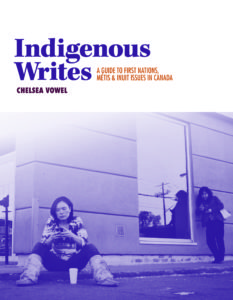
Last week's lecture included an interview that Tasha Hubbard (one of our professors) did of Chelsea Vowel, where they discussed how the book came out of some of the work she was doing on her blog creating "Indigenous Issues" Primers., as well as on her twitter and other social media.
They discussed how, if she was going to do this all over again, she would have avoided the use of the term "Indigenous Issues" as they are really Canadian issues. These primers discuss things all Canadians are involved in, and it is not narrowly about some subset of the population on this land.
I've heard it said in another way, which is that there never was an "Indian problem", only a "settler-colonial problem".
Repeating my confession
I haven't read every single stereotype and false notion discussed in the book yet, but in the past I've believed pretty much everything I've read debunked so far. I bought the marketing (AKA: propaganda) of Canada, from my birth in 1968 (on land covered by Robinson Huron Treaty) up until embarrassingly recent times.
I really was a good little white soldier, loyal to the empire and never thought to question the Imperial cause (Um... Wait... isn't that the definition of a Stormtrooper from Star Wars? I'll eventually get caught up on my studies and be able to listen to MÉTIS IN SPACE!).
However...
It is actually worse than that.
When I came across ideas which I now recognize as common to many Indigenous Nations since time immemorial, I assumed the idea was new and came from the white guy (usually male, but not always) that I heard it from.
The idea strongly resonated with me -- I had a feeling about wanting to learn from many generations and use that to plan for at least 7 generations into the future. I never thought of land or her resources as something we inherit from our parents, but that we borrow from the future.
However... As much as I've believed this, I also believed all of what Canada told me about Indigenous peoples. It never occurred to me that not only was this not a European (or descendants) idea, but that it has been (for instance) an ancient Haudenosaunee philosophy.
Chapter 13, also in a blog article, discuses "The myth of progress". This includes the myth of Canada progressing beyond defective settler-colonialism ideas, as well as the myths of the superiority of European contributions.
I fully believed the "indigenous savages" myth, so it never occurred to me that these "new" ideas I was hearing from White people were only new to White people. That in fact some of these were ancient ideas which the less civilized Europeans tried to eradicate as part of their settler-colonialism project.
Am I obsessed about "Indigenous" studies?
My wife thinks I'm obsessed with my Indigenous studies: I'm taking two university courses, reading many books. listeningtoseveralpodcasts and radio shows, and get my news and listening to concerts and watching movies from APTN Lumi. I talk way to much, and am way too excited, about what I'm learning (a common non-neurotypical trait). Sometimes she just wants to take a rest from everything.
While the courses I'm taking are from the Faculty of Native Studies, I think of this as Canadian Studies. While I am also learning about the peoples of the land I was born and live on, I am primarily learning about the foreign European derived systems that we have been indoctrinated to believe legitimately governs over this land. I have been learning what this foreign system has been doing to the Indigenous peoples of this land.
I've lived here for nearly 53 years, have an Ontario birth certificate and Canadian passport, and I'm only being introduced now. I think it is reasonable that I be a little bit excited (and several other emotions, sometimes all at once) about this.
The more I learn in my Canadian Studies courses, the more I realize how many of the ideas I've personally believed the majority of my life aren't Canadian (or White, European, Abrahamic, etc). Canada as a foreign system stands in the way of ideas that existed pre-colonial, and I have now come to hope to become dominant ideas again post-colonial.
Free land, resources, and no taxes for Whites
Since the 1990's I've believed our value systems were backwards. I have naively, as part of my learned racism, thought these values were near universal of humans. We put a value (and price) on human labour, manipulations of nature by humans, and other human activities. We don't value and thus give away pretty much anything that is non-human for free.
Land, and all the resources that come from the land, are largely transferred with tiny one time fees (if at all) as an ideologically constructed form of "property" (exclusivity without responsibility). This hasn't made sense to me since I was a teen in the 1980's, as I always thought of land and her resources as something that we are borrowing from future generations. I believed any form of exclusivity should be regulated by responsibility toward the future.
I found it interesting to read the “Free Housing for Indians” myth (chapter 16), given the land that a house sits on has far more intrinsic value than the house and yet Whites built entire economic systems based on "Free/cheap land for Whites". During the so-called "nation building" phase (more honestly, a nation replacing phase), White settlers were given free land as long as they "improved" it by chopping down trees and other such things using unsustainable management practices. And then this gifted land was "inherited" by or "sold" to other settlers as time went on.
One of the many reasons that left-leaning economic policy has never resonated with me is because of the narrow focus on the "ability to pay" when talking about taxation.
In the early 1990's I was primarily involved in municipal politics, and part of my shift to provincial politics was because of the Mike Harris years in Ontario. I considered the concept of "Market Value assessment" for municipal taxes to be entirely backwards. I believed municipal taxes should be assessed based on how much it cost to provide municipal services, how the use of land integrated with public values (walkability, protection of greenspace and prime farmland, etc), proximity to employment & enjoyment, and other such criteria.
While this policy change was brought in by a Progressive Conservative government the political-left hated with a passion, any conversations about moving away from this system for municipal taxes is aggressively opposed by the economic left. The political-left see it as a way to have municipal taxes be indirectly tied to "ability to pay" (if you can afford to live in an expensive home, you should pay more), and the political-right in Ontario see it as a way to favor their voting base (suburbs and rural end up subsidized by higher taxes in urban centers).
It is, however, consistent with western worldviews to only consider humans, human labour, and other human activity as having value. The cost of paving over prime farmland and forests to make "faster roads" and bigger houses in Ontario isn't seen as a massive loss, but as somehow being "progress".
I remember traveling to Toronto from Sudbury in my youth looking at the soil (amazing for growing) around what was being called the Holland Marsh that was being dug up to build a bigger highway 400. Human settlements and inefficient individualized transportation systems should be kept away from this area, not building close or on top of it.
Personally I consider it a telling aspect of "our" current society that fiscally and environmentally costly roads are paid for by taxes and considered "free" by everyone, yet high-speed digital communications within municipalities which have a many orders of magnitude lower cost and greater value in modern society are considered legitimate to be managed as a private sector service.
I've been asking for a very long time why road users aren't charged more taxes for their use of roads. But as typical in this White society, everybody doesn't get charged taxes for things which White worldviews believe shouldn't be taxed.
When it comes to resource extraction, the subsidies should be obvious. The tiny royalties that are being charged are largely kept in specific provinces, even though the costs of this extraction (including but not limited to Climate Change) is expected to be paid for by everyone (on Turtle Island and globally). While the most extractive provinces claim that they are the driver of the economy, they are in fact the driver of debt because the economic system doesn't account for the actual costs because it is giving away land and resources practically free. Again, free stuff and no taxes for Whites.
I find the "Indigenous peoples don't pay taxes" (chapter 15) particularly nonsensical given the entire debate around the carbon tax is a form of "White people don't pay taxes". It is built on this worldview where the actual costs of resource extraction should be subsidized off of taxes on labour, rather than resource extraction paying its own costs as well as a significant percentage of government services.
We should be seeking to phase out personal income taxes entirely, raising that money from resource extraction and human exclusive land use rents (IE: You pay yearly rents to municipalities and/or First Nations for exclusive access, not a one time fee and then perpetual exclusivity for free).
Income that is at or below a "moderate livelihood" should be tax free and paperwork free, and taxes on income should only apply to immoderate livelihoods.
The concept of a "moderate livelihood" is important to me. I believe land and other exclusivity-without-responsibility individual "wealth" is borrowed from future generations. I don't believe it should be inherited individually from ancestors. I believe that an amount of wealth up to 5 times a yearly "moderate livelihood" should be able to be transferred based on the wishes of an individual, but anything beyond that should be returned to the community upon an individual's death.
I've been an opponent of the GST since it was introduced. While I believe goods should be taxed, to ensure payment is made for everything from extraction to safe disposal, I have never believed that services or labour should be taxed at all.
If anything, we should be subsidizing specific type of labour such as repair by taxing manufacturing/importing higher. We should be instigating a "right to repair" law that goes far beyond outlawing the use of "technical protection measures" to lock down electronics (including farm equipment), but a positive right that requires manufacturers to make repairs easy as a condition for certification to be sold. (IE: I have a few WaterPic electric toothbrushes where the manufacturer deliberately made it harder to change batteries -- you need a soldering iron to do so. Manufacturers shouldn't be allowed to do that).
The focus on humans has made it impossible for the systems of Canada and other Western worldview countries to think in sustainable terms. They want the things which actually have a cost to be free and untaxed, and instead want government funding to come from the things which should instead be free.
But, this isn't about Whites, as everyone pays the same way?
I've had several versions of this conversation already, and my anti-racism training only started last year. I am barely beginning to imagine how exhausting it has been their entire lives for BIPOC.
While it is true that people largely pay the same taxes no matter what their skin colour, what does and doesn't get taxed, and what you do and don't have to pay for, is entirely based on European/White worldviews. Essentially, you can have whatever skin colour you want, but you must still live in a European (British) society that exists outside of Europe.
I consider it offensive that European systems of government impose themselves on peoples outside of Europe, which is the only place they legitimately exist.
The article First Nations farming in the Prairies (chapter 23) was informative in touching on how offensive the colonial government of Canada is in imposing its foreign ideologies. After forcibly migrating Indigenous populations to areas not suited to farming, and not delivering farm implements promised as part of international treaties, the Indigenous farmers were still successful. (Quoting from an academic article reference from the blog article):
During the early 1880s … many First Nations farmers were successful in competing in the farming economy along with the non-aboriginal farmers. Utilizing newly developed dry land farming techniques and acting as a collective, many First Nations won local prizes and awards for their crops
So what happened?
Settlers complained about the competition, and the colonial government stepped in by weaponizing European individualism. They knew that if Indigenous peoples were no longer allowed to act as a collective, or produce food for market, or even be allowed to leave reserves without permission, they could no longer pose a competitive threat to under-productive (lets just call them lazy, shiftless, untied and unfamiliar with the land, and less skilled) White settlers.
There you go, putting FNMI up on some sort of pedestal?
I understand why that might be a first reaction, and a few of my friends have made this comment in recent months.
If I lived in a settler municipality operating under an Anishinabek National government (given which parts of Turtle Island I've lived on during my life), there is no way for me to guess what I would be asked to pay for or how I would be taxed.
I don't often agree with the decisions made by my existing municipal, provincial or federal governments. I do not expect I would agree with every decision made by a municipal, National/Confederacy, or Turtle Island League of Nations(1) government built upon Indigenous laws and worldviews.
I am confident in believing that since the worldviews of most peoples, governments and Nations indigenous to this homeland are closer to my own, that it would be able to do far better than these European derived governments and other systems have been capable of.
I have no idea how governance would work. Pre-contact, Nations set up treaties between each other to share. Since European worldviews have been proven over centuries to be incompatible with sharing, I don't believe that model will work with the European settlers that are here. I don't think setting up White reserves would be a useful long-term solution, although something like that might be appropriate as a transitional measure.
I don't believe I should be given a vote in that decision, but my guess is that in the longer term something similar to an immigration process will be needed. Foreigners who are able to adopt into Indigenous worldviews could be welcomed, and other people allowed to temporarily visit (refugees/etc) but otherwise expected to return to their homeland if they aren't interested in adopting the laws, systems and worldviews Indigenous to this land.
I do, however, expect that there will be a (hopefully small) subset of people currently residing on this homeland that will never be willing to come into better relations with these lands and its peoples.
Honestly, if you really feel you must live under a European government, there are several in Europe to choose from.
(1) I suspect there will be a need to coordinate at a union of confederacies level, even if only for this northern part of Turtle Island, such as for trade and defense. Coordinating defense will be important given there are always going to be foreign nations that are going to want to steal the wealth.
I've been writing about association fallacies, and how they are leading to errors in analyzing UNDRIP, Bill C-15, and related laws.
Who created UNDRIP
UNDRIP is the result of decades of work, starting from the late 1970's, by Indigenous peoples worldwide. This included many representatives of Turtle Island Nations and peoples. The goal was to create policy which would regulate the behavior of nations which are not Indigenous nations.
It should not surprise anyone to know that the most offending nations, known collectively as CANZUS (Canada, Australia, New Zealand and the United States) would be actively opposing this human rights initiative. These foreign/foreigner created nations exist as an ongoing expression of White Supremacy.
These are nations where their colonization projects were so successful (meaning, so horrible and genocidal) that the foreign population and their descendants greatly outnumber the Indigenous population. Genocide is not what democracy looks like, so claiming that this demographic shift makes CANZUS nations democratically valid should be understood as morally offensive. It should instead be understood as the genocidal version of gerrymandering.
The legislative process at the United Nations was long and hard, and there was quite a bit of politicking at the UN to try to reach consensus as is normal for this type of policy.
The United Nations Declaration on the Rights of Indigenous Peoples (UNDRIP) was adopted by the General Assembly on Thursday, 13 September 2007. More details of the approximately 30 of years history, including the various meetings that lead up to the declaration, are available via the UN's UNDRIP page.
Once the declaration was passed, International pressure was exerted on the CANZUS countries to come into line, and years later the official positions of these governments changed. Some of the positions changed after the government changed. All 4 of the CANZUS countries use democratic systems based on their British heritage as former British colonies.
Back bench members of Canada's parliament didn't wait for the official government position to change. A quick look at the "Similar Bills Introduced in Previous Sessions" for Bill C-15 shows that several drafts of this style of bill were tabled before it was finally tabled as a government bill.
Tia Keeper (Churchill, Liberal) in June 2008 (less than a year after UNDRIP passed the UN General Assembly)
Denise Savoie (Victoria, NDP) in February 2009, March 2010, March 2010 (reinstated from previous session)
Romeo Saganash (Abitibi—Baie-James—Nunavik—Eeyou, NDP) in January 2013, October 2013 (reinstated from previous session), December 2014 (defeated at second reading), April 2016 (passed house, filibustered in the Senate)
Minister of Justice (Liberal government) in December 2020
Who/what does UNDRIP regulate
Reading UNDRIP and legislation that affirms UNDRIP it is clear to me what entities this policy regulates.
This is an International Indigenous initiative to regulate settler-colonial nations, and is not Canadian policy which regulates Indigenous nations or people.
Unfortunately there are people who have misunderstood the direction of this policy, and believe that it is a Canadian (or worse, CANZUS) initiative to further oppress Indigenous peoples.
UNDRIP and Bill C-15 explicitly include clauses which disallow this policy to be abused in that way.
Bill C-15 includes the following non-derogation clause (emphasis added):
2(2) This Act is to be construed as upholding the rights of Indigenous peoples recognized and
affirmed by section 35 of the Constitution Act, 1982, and not as abrogating or derogating from
them.
UNDRIP itself includes the following in Article 37 (emphasis added):
Article 37
1. Indigenous peoples have the right to the recognition, observance and enforcement of
treaties, agreements and other constructive
arrangements concluded with States or their
successors and to have States honour and respect such treaties, agreements and other constructive arrangements.
2. Nothing in this Declaration may be interpreted
as diminishing or eliminating the rights of indigenous peoples contained in treaties, agreements and other constructive arrangements.
Put another way, if a Canadian government (federal or provincial) tries to abuse UNDRIP or an affirmation law in a way that is harmful to the rights of Indigenous peoples, then that government is in violation of that law and human rights instrument. If Canada is taken to court (domestic or international), it will lose for violating the law.
It is true that the existence of law doesn't stop governments from breaking the law. The fact that this is international law created to put international pressure on Canada means there will be consequences. Canada violating this human rights instrument will have international relations impacts, likely including trade relations. My hope is that the UN will actively send human rights observers to Canada to monitor and internationally report on progress. Canada has proven to not be trustworthy enough to be allowed to do this on it's own.
Canada promotes itself domestically and internationally as a law abiding nation, and a protector of human rights. The more it is recognized that this is a myth, the more pressure will be exerted (domestically and internationally) on the Canadian Government to stop its ongoing violation of human rights, and to make amends.
We can ask why, after the federal general election in 2015,
the new Liberal government didn't table and pass this bill immediately. That would be based on an association
fallacy as this isn't a party partisan issue: The governments of Canada, provincial and federal, whether Conservative (progressive, united, whatever), Liberal or NDP, are not
keen on this policy and are only bowing to international and domestic pressure.
Even
after a Canadian government passes legislation, as happened in BC under an
NDP government, there will be a desire to ignore it or find loopholes. The BC NDP
government went so far as to claim the policy doesn't apply to
activities before their bill 41 passed in 2019, which is nonsense given this policy
actually applies to activities since the UN resolution passed in 2007. The federal Liberal government is likely to try the same type of dishonesty, but they will be in violation of the declaration and will lose in court.
To repeat: there is no lawful way for this policy to be interpreted to regulate or harm the rights of Indigenous peoples. This is an International regulation of Canada, not a Canadian (federal or provincial) regulation of Indigenous peoples.
In my last article I discuss some of the mistakes that settlers regularly make when trying to understand and help with policies that impact Indigenous peoples on Turtle Island.
With regards to Bill C-15, I am most concerned that some settlers have read emotional statements made by a subset of Indigenous individuals that are justifiably upset with Canada for the ongoing genocide against Indigenous peoples. These settlers will then incorrectly believe that it is helpful to protecting the rights of indigenous people to also be angry at Canada and oppose Bill C-15 and any other activity Canada might take relating to changing Canadian law to conform with UN human rights declarations.
While I respect and understand Indigenous people who simply want Canada to get out of the way and allow them to live their lives in peace, I do not believe settlers should allow themselves to think the same way. Whether settlers support Canada or any of its institutions, they are still part of and uphold that system. Duty demands that they participate in helping to dismantle it.
Given the reality of what Canada continues to do to Indigenous peoples, there is obviously no reason for them to trust Canada, or any of its institutions (parliament, courts, law enforcement, political parties or their leaders, etc). This extends to a mistrust of institutions which Canadians incorrectly think of as Indigenous such as Indian Act "band councils", or even other groups recognized by the Canadian government such as the Assembly of First Nations. I discussed in the last article about Canada sending in the RCMP to depose democratic governments that are responsible to their citizens and installing "band councils" which are responsible to the Canadian Crown.
I don't call these countries the Axis of White Supremacy merely because they voted against this declaration, but because these are four self-called "Nations" created by Europeans outside of Europe as an act of White Supremacy. Their colonization projects have been so "successful" (IE: so horrible and genocidal) that foreigners greatly outnumber Indigenous peoples.
Unlike immigrants given permission to live in a country by a domestic government, these foreign created governments (Canada, USA), and thus the foreigners and their descendants, aren't honoring the treaties that allowed them to be on the land. This makes these inhabitants more appropriately thought of as illegal aliens. Indigenous peoples have an inherent right to be here, and to decide who else they wish to invite to be here. The rest of us do not.
The legislative process
Some of the anger has been based on the fact that the declaration that passed the General Assembly is not the identical text of earlier drafts. This is part of the legislative process, whether at the United Nations or within the Canadian parliament. An assembly doesn't simply vote yes/no on a single draft tabled before them, but study and debate the draft, propose amendments, and then eventually an amended document is passed.
That resolution being passed by the General Assembly is also not the end of the process as far as the United Nations is concerned, and there is quite a bit of work expected in upcoming decades.
What is currently numbered C-15 also had multiple numbers over the years since it was first tabled by Tia Keeper in June 2008 (Less than a year after UNDRIP passed the UN General Assembly). Most people agree it is now a better draft, even if there are specific clauses that they would prefer were reverted to an earlier version. There is special support some people feel for the draft of the bill that passed the House of Commons and was stalled in the Senate prior to the 2019 election.
The legislative process will often not result in exactly what any specific individual will want the result to be. However, opposing legislation because it isn't your favorite wording isn't logical if the legislation will still improve the systems the legislation is intended to impact.
While I have heard many people indicating ways in which UNDRIP and the Canadian legislation to affirm UNDRIP in Canada can be changed in ways that they would prefer, I have yet to read a document that passes a basic scan for logical fallacies documenting how UNDRIP (as passed) or the Canadian affirmation (any draft) makes the status-quo worse.
Association fallacy, and Straw Man arguments
The simplest way to understand the analysis which leads to opposition is to understand the Association fallacy:
An association fallacy is an informal inductive fallacy of the hasty-generalization or red-herring type and which asserts, by irrelevant association and often by appeal to emotion, that qualities of one thing are inherently qualities of another. Two types of association fallacies are sometimes referred to as guilt by association and honor by association.
In my last article I discuss two ways this actively plays out in this discussion.
Honor by Association
Anyone following Indigenous issues will know that various groups of land defenders and "Idle No More" are at the forefront of Indigenous activism in Canada. This is not something that can legitimately be questioned.
A document is being published by Defenders of the Land, Idle No More, and the Truth Campaign is being granted "Honor by Association" with people assuming that since these individual organizations are doing amazing work, that there is no need to apply any critical analysis to the document. The document states that "UNDRIP Bill C-15 deeply flawed and must be rejected say indigenous networks and land defenders", and thus many settlers will write letters to their MPs and otherwise advocate against UNDRIP and Bill C-15 based on this.
I have asked, but have not been able to determine the process used to generate that document. Did it have peer review? Were multiple authors involved building consensus?
The only individual that has stepped forward in online discussions and quite a few interviews to indicate they were actively involved in authoring is Russ Diabo of the Truth Campaign. I've tried contacting the other groups indicated to be involved, but have received no reply.
(Please let everyone know if you know more about how the document was drafted!)
For all I've been able to determine, the support of this document by these groups is entirely built on trust people have for Russ Diabo. It is not a diminishment of his critical activist contributions to recognize that he is human, and that strong emotions can lead to errors in analysis. Critical analysis is needed no matter who the author of a policy document is.
Guilt by Association
Many other Indigenous individuals and groups have been promoting this bill, including many that have been involved in the process leading up to the declaration and this Canadian affirmation since the 1970's and 1980's.
The "problem", according to the opponents, is that all of these individuals and groups have some direct or indirect connection with Canada. They are or have been members of the Canadian parliament, they are or have been members of a "band council", or they are or have in some ways worked in the Canadian system as lawyer, etc.
The suggestion is that all of these individuals are tainted by having ever come in touch with the system.
I've found this part of the discussion confusing as Russ Diabo ran for AFN National Chief in its 2018 election. Had he won that election, it would have put him into the same category of Guilt by Association. I find it interesting that in one of the articles written about his candidacy he appeared to be focused on Justin Trudeau, which I consider to be an example of the association fallacy. I think Russ Diabo's dislike for Justin Trudeau has clouded his evaluation of a bill which Trudeau doesn't want, and is only being tabled by the current government because they are receiving international pressure to do so.
This type of ad hominem argument will be particularly problematic if you are discussing on social media, as people will demand you justify your opposition to their alleged association. You won't recognize their association to be remotely related to UNDRIP or Bill C-15, and will feel attacked for things which you have never said or thought. Any desire to not address the incorrect association is claimed as somehow being proof of a problem with the argument of those who have not fallen victim to this fallacy.
Fallacies
Some common examples of fallacious statements, fallacious associations, or ad hominem statements. Some of these can feel like personal attacks, so be prepared when you engage in this area of politics.
You aren't Indigenous, so you shouldn't say anything. This has even been expressed as "It is not our job as non-Indigenous people to judge UNDRIP or to judge Canada's implementation of it. That is the job of Indigenous people."
This is intended to be a Traitorous critic fallacy but is particularly problematic given it is actually our duty, obligation, and not merely our job as part of (and benefiting from) the problem to put energy into being part of the solution.
Leaving all the heavy-lifting to non-Canadians (or non-settlers, or non-Whites) to amend Canadian law is, in my opinion, quite offensive. There is a common anti-racist critique of those who claim only those directly harmed by racism and White Supremacy should be fighting against it.
"I see you've transferred your political affiliation from red to orange. That's fine."
There is a generalized version of this, but that is a unique quote from someone who knew and disagreed with me from my advocacy on electoral reform where I strongly oppose systems which grant political parties and their unaccountable leaders more power. In this case I was supporting ideas presented by Leah
Gazan and Romeo Saganash who happened to sit as NDP caucus members . We were
discussing a bill tabled by both NDP (Orange?) and Liberal (Red?)
caucus members, and which was currently a government bill (Speaker's chair is green with a carved oak and ebony screen behind?). It isn't clear which of Orange or Red I was allegedly affiliated with,
but the answer has always been neither. When I was young and partisan in the 1990's I was affiliated with very different and less partisan Green Party.
The generalized version is the belief that what Canadian political party a person is from is relevant on this policy. This is not an Liberal, NDP, Green, Conservative or Bloc bill, but a bill that affirms that an international human rights instrument applies to Canada. The instrument already applies, but this bill affirms it and sets up a process to force the government of the day to make progress in correcting existing laws which violate human rights.
Partisans in BC blame the NDP for provincial violations of UNDRIP after they passed a provincial version of this bill, and
partisans federally blame the Liberals for violations of UNDRIP. If the Purple Party was in Power, Partisans would Pronounce them the Problem.
Hyper-partisans believe that party affiliation has to do with everything, but in this case it is clearly another fallacy.
You want to gain personally as a white person from the rights being taken away by UNDRIP and/or Bill C-15?
See above, with this being the angry personal attack version of this fallacious statement
You don't consider Idle No More or land defenders (generally) trustworthy?
You blindly trust everything said by the specific institutions that happened to have been at the press conference discussing C-15?
"person or group X" believe that UNDRIP article Y means something harmful, doesn't that negate UNDRIP in Canada.
Actually, it usually indicates an error in interpretation by "person or group X", whether it is a Canadian government official or an Indigenous activist.
The legislative process at the UN leading up to the passage of the resolution in the UN General Assembly was complex and involved changes to the draft, doesn't that negate UNDRIP?
That is how pretty much all policy works in democratic institutions, and what some call "watering down" others call democratic politics in complex institutions. Unlike some Turtle Island Indigenous governance systems, the UN does not use a transparent consensus model so the UN model is in fact less complex (or some might equally say "less advanced").
BC continued to violate UNDRIP after passing their provincial law, doesn't that negate UNDRIP?
It is important to recognize that passing a law, and having a government obey a law, are two entirely different things.
Canadians get very confused on this as they believe the myth that Canada and it's provinces are law abiding jurisdictions. Canada and its institutions break its own and international law every day. That is not a problem with the law, but a problem with Canada! Canada is regularly caught in courts and tribunals violating laws and human rights, and the fact that Canadians aren't more aware of this is a fault of settler Canadians for not paying attention to the truth about their own country!
Canada is passing a bill to make UNDRIP subservient to the constitution, and thus weakling it by domesticating it?
This is a basic misunderstanding of how law works, as all Canadian laws are -- well, domestic Canadian laws.
Passing a law in Canada doesn't "domesticate" international law as certain international law, such as UN Human rights instruments, don't need domestic legislation in order for them to be enforceable within and against Canada.
But Justin Trudeau? (Or any other politician you can name)
This is policy that received extensive international consultation over many decades, far longer than Justin Trudeau has been a member of parliament or the Prime Minister.
What Justin Trudeau does or does not think about UNDRIP is largely irrelevant, except if he was opposing UNDRIP or threatening to withdraw from UN institutions.
But the Liberal Party? (Or any other colonial federal or provincial party)
In Fact Checking the 2019 Liberal platform commitment on UNDRIP I was critical of the use of language that wasn't helpful during the campaign. While this might be reason to not trust a Liberal nominated candidate during the next election, it is fallacious to believe that mistakes made by the platform team have impact on UNDRIP related policy.
Do you agree with Canada and its provinces ignoring human rights tribunals?
What about the Canadian Human Rights Tribunal order against Canada on Jordan's Principle, and Canadian officials indicating they plan to ignore it?
This is a duplicate of the general association: Canada is not a law abiding country, but that is not reason to stop passing laws, or courts and tribunals not calling Canada out for its numerous violations. In fact, it is reason to push forward with more laws that clarify just how unjust of a set of institutions the Governments of Canada really are.
"Place the two documents side by side (that is UNDRIP and CanDrip)..."
CanDrip is the name that people who have fallen for a series of these association fallacies have given to UNDRIP when it has any connection with Canada.
In one case someone was comparing a draft of a resolution to UNDRIP as it was passed by the UN General Assembly, and as included verbatim in Bill C-15 (and earlier versions).
There is no way to compare the text of two different things as there is only a single thing, which is the declaration as passed by the UN General Assembly on 13 September 2007. Other drafts are drafts, and have no relevance to a discussion about UNDRIP applying in Canada.
The UNDRIP affirmation bills include the text of the passed UNDRIP resolution verbatim within them.
"They are proceeding without the Free Prior and Informed Consent of Indigenous people by ramming it through using Canada’s imposed band council system."
"Free, prior and informed consent" (FPIC) of Indigenous peoples is required when a colonial and/or settler state carry out various activities which impact Indigenous peoples.
FPIC of the settler and/or colonial state is not required when Indigenous peoples, their Nations, or the United Nations exert pressure on these states to come into compliance with human rights.
UNDRIP and the pressure for Canada to come into compliance with it, such as through the Bill C-15 process, are Indigenous lead initiatives that have been ongoing for many decades. These are not Canadian initiatives, and no alleged association with Canada or any of its institutions (including the "band council" system) is a reason to oppose those Indigenous lead initiatives.
We should all be calling out Canada for continuously delaying initiatives towards coming into compliance, not opposing Indigenous and international pressure being exerted on Canada to come into compliance.
In general most of the fallacious arguments that are claimed to be against UNDRIP or Bill C-15 are actually arguments in favor. It is not the statements of these individual facts that are incorrect, but the problematic application of logic leading to the opposite conclusion than these facts support.
Discussing the Analysis of UNDRIP and the bill to affirm in Canada
Leah Gazan is a member of Wood Mountain Lakota Nation, located in Saskatchewan, Treaty 4 territory. She was elected to the Canadian House of Commons for Winnipeg Center in October 2019, but has been actively involved in promoting the UNDRIP affirmation in Canada for decades. She was interviewed on a recent episode of One Dish One Mic (Start at 14 minutes if you only want to hear about UNDRIP, but the entire interview is important for context). Like many other analysis of the bill, she directly addresses some of the critiques from fellow Indigenous people and indicates how they interpreted the bill, the UN resolution, and the legal process incorrectly. Addressing critiques who have coined the term "CanDRIP", she clarifies that is entirely false. As she has been advocating for this policy for decades, she will obviously be voting in support and likely has been doing quite a bit of work within parliament to educate non-Indigenous parliamentarians about this policy. It is also no secret that Romeo Saganash is Leah Gazan's partner.
Understanding Bill C-15 , which goes over the actual text of the bill and includes references to how to interpret the law. Reading this document will help to understand some of the mistakes that people with less legal or political background have made.
This is what we fought for:
An open letter in support of implementing the UN Declaration on the
Rights of Indigenous Peoples
The Yellowhead Institute created a Special Report on the experience so far in BC, and the ongoing work that will be needed once Bill C-15 (or a related draft) eventually receives "royal ascent" federally and in other provinces.
None of these Indigenous lead groups or individuals are opposed to UNDRIP or attempts to have Canada or any of its provinces to affirm UNDRIP or upgrade existing laws to conform to current international human rights norms. They are all concerned that Canadian governments are dragging their collective feet and taking way to long to do the right thing, both in terms of passing legislation as well as honoring the existing laws and rights.
They all want this policy passed as soon as possible so that we can move onto the next steps. They all recognize that the Canadian governments violate their own law and human rights today, and that they will continue to do so the day after a bill is passed. They recognize this is not a logical reason to oppose the bill, but is a reason to push hard to ensure that passing the bill (as quickly as possible) is never claimed to be the final goal but only a necessary first step.
So, the opposition?
I am still uncomfortable providing a paragraph by paragraph critique of the position paper by the "indigenous networks and land defenders". I believe the logic that they used to lead them to opposition is built on flawed logic and/or misunderstandings of the law or democratic processes.
I don't want anyone who might easily fall prey to association fallacies to fail to honour and respect these individuals/groups and the critical work they are doing. I just don't want anyone incorrectly trusting their opposition to policy when the arguments used in that document suggest we should be strongly supporting rather than opposing.
If anyone has a specific question about a specific paragraph that they feel does not fall into the fallacies I have discussed above, please ask and I am more than willing to do any research necessary to provide an answer. I recommend reading the PDF from the Media Co-op site as you can easily cut-and-paste from that version.
"If it passed unanimously..." #BillC15 - Professor Brad Morse, Faculty of Law, Thompson Rivers University
An amazing thought!
That would ease the worry that a later government may rescind. Unfortunately I don't think certain special economic interests will allow..
This article caused me to realize something about my own activism around Indigenous political issues, including LandBack.
I'll offer some context first. When I started my self-directed antiracism training, some key books helped give me the language and context of everything I've learned since. There are two key aspects of that reading that direct my activism:
Individuality as a form of white privilege. Whites see themselves as individuals, but they see non-whites as representatives of entire groups. This leads to huge misunderstandings. One is the notion there is a pan-Indigenous perspective on any issue.
Individual prejudices vs systemic racism.
Turtle Island Diversity
It is useful for people to look at a map of what some call North America, and others call Turtle Island. This represents 24.7 million sq. km, or 16.5% of the Earth's total land area, vs. Europe's 10.2 million sq. km, which is 6.8% of the Earth's total land area.
Turtle Island and Europe have had human inhabitants for tens of thousands of years, and developed their own civilizations, including their own origin stories, religions, governments and nations.
One of the myths that Europeans spread was that when they visited Turtle Island they didn't find nations or civilizations. In fact, the only thing they didn't find were subjects of Christian European Monarchs, and then declared (as demanded by their pope) anyone who wasn't a Christian or a subject of these Monarchs to somehow be lesser.
While something like the European Union didn't form until 1993 and with Brexit didn't survive a full 30 years before losing a member, the participatory democratic Haudenosaunee Confederacy became 6 nations in 1722, and was a confederacy of 5 nations possibly since 1142.
The Haudenosaunee is a matrilineal society where the responsibility for land falls to women. Every time I hear Skyler Williams, spokesperson for the pro-democracy freedom fighters at 1492 Land Back Lane, talking about needing to get direction from the clan mothers I am in awe. I wish the governance systems I live within had comparable ways of making decisions and having spokespersons convey rather than having a person dictate from the the top of a hierarchy.
This is a strong democratic society that has existed for hundreds of years. It should embarrass anyone who thinks of themselves as Canadian to know that Canada sent in the RCMP to depose this democratic government and install an "elected" band council bureaucracy that is responsible to the Canadian Crown and not Haudenosaunee citizens. Every day that Canada refuses to recognize this democratic government, and doesn't fold the anti-democratic band council, is an additional stain on Canada.
The Anishinaabe, like most Anishinaabemowin speaking (Western historians/anthropologists call Algonquian) groups on Turtle Island, are patrilineal. This is not to be confused with the more western notion of the patriarchy, as women have much greater decision making roles in pretty much every Turtle Island nation I've become aware of than in European societies. As with the Haudenosaunee, attempts at consensus building is the preference over the more top-down decision making more familiar to Europeans. This grouping includes Ojibwa, Odawa, Potawatami, Chippewa, Mississauga, Algonquin, and Delaware nations.
This is 13 nations within the largest two confederacies/unions within what Europeans called the Province of Ontario, and that doesn't include all the nations within these arbitrary European-drawn lines.
Europeans easily think of there being huge differences between European nations, such as British compared to Serbians, or even between the British, French, Spanish and Dutch who set up colonies on Turtle Island. The historical connection to France that a subset of people in Quebec have causes them to think of themselves as a "distinct society".
The different histories of Europe and Turtle Island has actually allowed there to be greater diversity on Turtle Island. While most Europeans share the same origin story as depicted in the book of Genesis that is common for Abrahamic religions (most known being Judaism, Christianity and Islam), there is a wider diversity of origin stories and derived worldviews on Turtle Island.
Beyond Turtle Island diversity, which suggests a lack of their being a pan-Indigenous perspective, I have also noticed that most nations try to build consensus rather than use hierarchical authorities. Indigenous governance tends to be more transparent than western governance, which has caused no end of confusion for westerners collaborating with Indigenous nations.
This means that settlers must engage in critical thinking and comparing a wider variety of perspectives. They should not try to look for a single authoritative source of a pan-Indigenous perspective even if a perspective appears to be from a respected group. If you don't know the governance process that was used to generate a document, you have no way of knowing how many people a given viewpoint represents, or if it had peer review or consensus building behind it.
Mistakes made by looking for (or believing in) an authority for a pan-Indigenous perspective commonly leads to the association fallacy type of "honor by association".
Individual prejudices vs systemic racism.
I think this is the hardest concept for people to come to terms with, given an ideology of individualism is pushed onto westerners from birth. My background as a systems administrator gave me an advantage in my reading that others may not have.
Earlier when writing about Systemic Canada I discussed how many Canadians can't understand systemic racism, because they believe this is the same thing as an individual racist or a group of racist individuals. They know there is a difference between socialism (the system) and a socialist (a person), but have been hardwired to not understand the difference between racism (the system) and a racist (a person).
This leads to unfortunate confusion. Whenever a systemic racist activity happens, people want to blame the individuals involved as if they had a choice. The systems which are racist include the law, and so if you are a law abiding Canadian citizen (or law enforcement) you will carry out racist activities -- not necessarily even being aware of it.
I firmly believe that if there wasn't a single racially prejudiced person in Canada, and yet the Canadian systems were kept intact, that racism would be intact and these "not racist" individuals would continue to carry out racist activities. That is what the systems of Canada direct them to do.
Only by changing the systems can we stop Canada from encouraging and/or forcing Canadians to carry out racist activities.
This confusion is not limited to white settlers, or even to settlers. I have heard many accounts of a mistrust of individuals (A Prime Minister or Premier, caucus members, a political party, any party that forms government, etc) because they carry out racist activities. They don't trust "the same people" to be capable of being involved with a positive change (IE: passing any bill, including C-15) because they believe it is the individual people, rather than the system, that is the source of the racist activities. They believe that if only different people were put into those positions of influence then the problem would go away. Somehow we are to elect, for instance, a Prime Minister of Canada who would disobey the laws and other systems of Canada and thus not engage in racist activities.
We have had Prime Ministers from a series of parties: Liberal-Conservative, Liberal, Conservative Party (historical), Unionist Party, National Liberal and Conservative Party, Progressive Conservative Party, Conservative Party (new).
Each of these governments have carried out racist activities, and ongoing genocide against Indigenous peoples.
The NDP party has formed provincial governments, and have carried out the same types of activities. Some of the most common critiques come from people who believe that the problem is unique to the Liberal and Conservative parties. While I see individual members (including elected caucus members) doing great work, the Canadian federal and provincial parties all maintain foreign Eurocentric systems.
It is the system that is flawed, including the fact that Canadians seem to want to build top-down party-driven democratic institutions which itself is based on western worldviews. The fact that so many people are focused on the person who becomes the Prime Minister is part of the systemic failure.
A focus on individuals rather than systems commonly leads to the other form of association fallacy: guilt by association.
Theories of Change...
This finally brings us to the Letter to Communities by Eve Tuck, which discusses theories of change. That article focused on research theories of change borrowed from litigation discourse for a damage-centered framework, compared to trying to capture desire instead of damage.
When I think of the pro-democracy freedom fighters at 1492 Land Back Lane, or other groups fighting for Indigenous self-governance and LandBack, I do not think of a damaged people that need my help to be protected. I think of a peoples who have demonstrated resilience. This makes me in specific ways feel envious of their future potential, if only they were given back their ability to direct their own future that the systems of Canada has temporarily revoked.
I know part of my white privilege in not having the Canadian Government attacking me, but I think of the Canadian Government and the systems it upholds to be the thing that is broken to the detriment of everyone on this northern part of Turtle Island.
I believe that some of the ways of changing Canada may have to involve litigation, as the systems of Canada aren't going to change without being forced to do so. This is going to involve domestic courts as well as international courts and tribunals.
This is going to involve education, but not about a damaged people but of a fundamentally flawed foreign system of governance which I personally believe has no place on Turtle Island. The creation of the USA and Canada are in and of themselves acts of White Supremacy , and I personally believe the long-term goal should be Indigenous governance throughout Turtle Island. While sharing amongst nations has been possible with other nations, I believe the last few hundred years has firmly demonstrated the inability of systems built from European worldviews to share.
The only way I can think of to move forward is to incrementally change the systems of Canada to move away from its White Supremacy in parallel with Indigenous self-governance and LandBack such that there will be a point where residents no longer see the point in retaining any foreign governance systems.
My activism
I'm not going to assume any position presented by an Indigenous person to represent some pan-Indigenous perspective. I know I need to engage critical thinking and access as many perspectives as I can, and ask questions of proponents of a position when it is not clear to me. Only once I have done my homework can I then engage in promotion or opposition to a given policy.
Warning: If you do that, you will have some white settlers telling you that you are not allowed to ask questions, and that you are only allowed to listen. Be prepared for discomfort, as there are additional dynamics in this type of activism beyond already uncomfortable heated political debates.
The most confusing response I've received is white people trying to "call me out" for allegedly believing in a pan-Indigenous viewpoint because I don't agree with a specific viewpoint which they appear to consider to be pan-Indigenous.
It is not the job of BIPOC peoples to alone fix problems observed in the Systems of Canada. They are already targeted by this fundamentally flawed system, so we must harness the privileges we have been granted by this white system in order to help dismantle it. One of the many privileges we have is that at the end of the day we get to just go home and rest -- as white people the racist systems of Canada do not follow us into every aspect of our lives, so we have the privilege to be able to rest between our chosen political engagement with these racist systems.
This is hard emotionally draining work that requires we be aware of the need for self-care.
Warning: If you do that, you will have both settlers and Indigenous people telling you that a given area of policy is none of your business to be involved. If the discussion is about policies an Indigenous self-government is enacting then it is none of your business, as settlers should stay clear of any commentary on Indigenous government.
Some white settlers believe the only role they are allowed to have is to amplify indigenous voices, without any critical thinking about what those voices might be saying.
When discussing changes to the systems of Canada, it is our duty to be involved. Expect discomfort and confusions, as you will simultaneously have Indigenous people who agree with what you have learned applauding your harnessing your privilege, while you will have people (primarily white settlers so far in my experience) who disagree with you going as far as to suggest you are "whitesplaining" things.
I'm going to try to alert fellow white people to some of the mistakes we tend to make. This will always be hard to do as most people have not yet done the reading to even be aware that there is a "white" perspective on politics. We have to learn how to engage, including learning about the above mentioned issues. Nobody ever wants the way they are thinking to be questioned, even if some educational work is a critical prerequisite to being able to navigate these areas of policy.
Warning: If you do that, expect strong push-back.
I observed settlers writing letters to their MP based on a single perspective on an issue (in this case Bill C-15). As they were writing MPs without doing the research and critical thinking first, I have tried to intervene to suggest there are alternative perspectives. This launched one of the first times a white person accused me of "whitesplaining", which was something I hadn't prepared myself for and it threw me off.
Mistakes will be made...
I have made mistakes, and you will make mistakes. As white people we have had the privilege of being able to be oblivious of racism, so need to put in the work to learn how to be helpful in dismantling it.
I have 52 years of life experience to re-evaluate as I unlearn false notions and replace that with what I'm learning now. I'm not always going to be able to avoid those false notions taking temporary control.
The most common mistake I keep making is to express my excitement in what I am learning in a very wrong way. I wrote earlier about My privileges, and my systems mental block around race in the hopes that other people can learn from my mistakes and avoid them. I'll do the same here with one example:
This is a really foolish thing for me to have said, especially after having read many articles, and parts of books, explaining why it is stupid. And I said it in public, and it's up there for all to see (until Twitter fades away into nothing). In the moment I went one further foolish to ask the author if they were being sarcastic?
Even if you don't want to read any of the books and articles I have, a quick web search for `"not all white" racist` will bring you to articles such as Yes My Dear, All White People Are Racists. It is written by someone in the USA, but Canadians need to get over the myth that the systems of Canada aren't also built firmly upon racism and white supremacy.
A social media friend brought up the topic of their work and how they weren't just lucky, but put a lot of work and schooling into their career.
This made me think about my own situation.
I feel privileged in my career -- beyond lucky.
I have one attribute which in some ways is a disadvantage, which is that I'm not likely neurotypical. I was lucky in that people (such as amazing teachers) directed me towards a profession where that personal feature was a benefit, even if there are regularly translation problems when communicating with more neurotypical coworkers.
I also entered into this profession in the early 1990's at a time when neurodivergences were not seen as a problem, while today things have become a bit more complex and neurodivergences gets people into conflicting situations with some interpretations of other diversity.
I am quite aware of my white cis-hetero-male privilege, where I don't have to be as exceptional as non-cis-hetero-male or non-white counterparts in order to get recognized.
I obviously did some of my own work, but I am fully aware that I never had to do as much work as other people who don't have the same demographic traits as I do in order to gain as much advantage as I have.
I was growing up at a time when my parents/grandparents were of a generation where there was a stronger work ethic, which I picked up from them. I was never told I was entitled to things simply by existing, but that I had to work for them (although I was never told about my privileges, but that is separate from this advantage).
I want to expand on my growing understanding of white privilege.
This is an idea that took me decades to come to better terms with, and I have been thinking about why.
When my wife and I first met, she was taking her Masters of Education at UofT (Ontario Institute for Studies in Education), and one of the classes she was taking was on social issues and feminism. The discussion of affirmative action came up, and as a typical white person I thought of myself only as an individual, and thus was opposed to affirmative action. As I've written elsewhere, thinking of yourself only as an individual pulls you out of time and makes you oblivious to your connection to the past or future.
Over time I started to change my opinion from being a strong opponent of affirmative action, to being neutral, to now supporting in specific circumstances.
Part of the problem was that the majority of what I saw discussing privilege was focused on nuclear family economics. It discussed how if you had wealthy parents you were likely to inherit many advantages throughout your life, far beyond the western concept of inheritance (wealth being something you inherit from your parents, as opposed to understanding it as something you borrow from the future).
The problem with the economic focus is that many white people also grow up poor, and thus aren't able to see that they ever received any privilege.
This last year my wife and I have both been reading books on anti-racism. A Eureka moment came for both of us when she was reading the book Me and White Supremacy: How to Recognise Your Privilege, Combat Racism and Change the World by Layla F. Saad. I haven't had a chance to fully read it yet, but Rina read a passage that talked about how BIPOC who succeed have to be exceptional, while those of the dominant race do not. A white person will be seen to "fit in with the team" and "be a team player", be treated as an individual rather than a representative of their race, and many other things. This won't only impact your job and money, but many other social aspects of your life which are part of success.
While money may be what people wish to talk about, it is about far more than that. Even if you did not receive an inheritance, it does not mean you didn't receive advantages that other people with the identical financial circumstances did not receive.
With this context, watch the short film made for the African American Policy Forum. While they also mention the concept of monetary inheritance, notice that this is not the only difference mentioned. The demonstration of the different starting lines I've seen elsewhere doesn't convey the multiple different factors as well as this video does.
The primary reason I currently support some forms of affirmative action is that I recognize, especially on Turtle Island, that there has been an (imposed) government policy of affirmative action for whites for several hundred years. With this promotion of white/European worldviews and values came the patriarchy and other problems where affirmative action is being used.
I have yet to see any advocate for non-white affirmative action suggest anything as aggressive as the white affirmative action: no removal of the right to vote, no residential schools, no stealing of land (both according to European law and laws of nations indigenous to Turtle Island), no misappropriation/theft of "trust" funds, no kidnapping and forcing people into forced labour/slavery, no genocide, etc.
I believe it is possible that correcting this white affirmative action will take less than the hundreds of years of unjust enrichment that white affirmative action has granted. This will depend on how long white supremacy is allowed to continue within the largest foreign-created governments (USA and Canada) that continue their existing policies of white supremacy and white affirmative action.
I remain skeptical of "equality of outcome" measurements, as that presumes that providing equal outcomes within the current (white) system of values will bring us away from systemic racism. I strongly believe in equality of opportunity, recognizing that not all peoples are driven by the same goals and thus with true equality of opportunity we will see less white-centered outcomes or criteria for success.
I want to highlight one of my major failings, in the hope that it can help others avoid it -- possibly much earlier in their life.
In an earlier article I discuss how I analyze public policy using my experience as a systems administrator and software author.
In the 1990's I was a big promoter of consumer activism, believing that if we only made better choices as individual consumers we could change the world. This lasted for about a decade until I came to the conclusion that while devoted activists can avoid specific problems, that there were systems in place (taxation, government subsidies, cost externalizations, social forces, media, laws and other policies) that made it difficult if not impossible for most people to make similar choices. I never got a drivers license or owned a car, but that alone has had no impact on anything else other than me and some members of my immediate circle.
I moved to focusing on systems for the policies I was involved in. My being neurodivergent probably helped, partly as I don't see or feel the same social pressures to conform as other people might. I currently strongly believe that only systemic change can impact over the longer term, as changing individual peoples minds without changing the system will allow the system to cause a social "reset" as people simplify their lives by conforming to the system.
Even with this systems focus in my work and political life, I did not see the systems aspects of racism.
The article where I discuss how I analyze policy includes a picture of Justin Trudeau, my wife and I. My wife's parents were born in the province of West Bengal in India, and I likely see brown skinned people as often (if not more) as I see white people in my personal life.
Even with this very personal family and community aspect of my life, I did not see the systems aspects of racism.
I had all the opportunities for me to understand handed to me, and yet it took me until this last year to start learning.
My hope is that by publishing my own failure that it might help other people to be aware of the possibility, and to seek to avoid it themselves.
I'm willing to discuss more if anyone wishes to reply to this blog, or open dialog on social media. Or post their own thoughts on their own blog, and let me know.