Showing posts with label Haudenosaunee Confederacy. Show all posts

Tuesday, June 14, 2022

"terra nullius" continues: British North America ("Canada"), Denmark, Russia.

A friend asked me if they heard about Canada and Denmark sharing the land border?

I immediately thought: Here we go again.

I looked it up and found a CBC article with headline: Canada and Denmark reach deal to divide uninhabited Arctic island
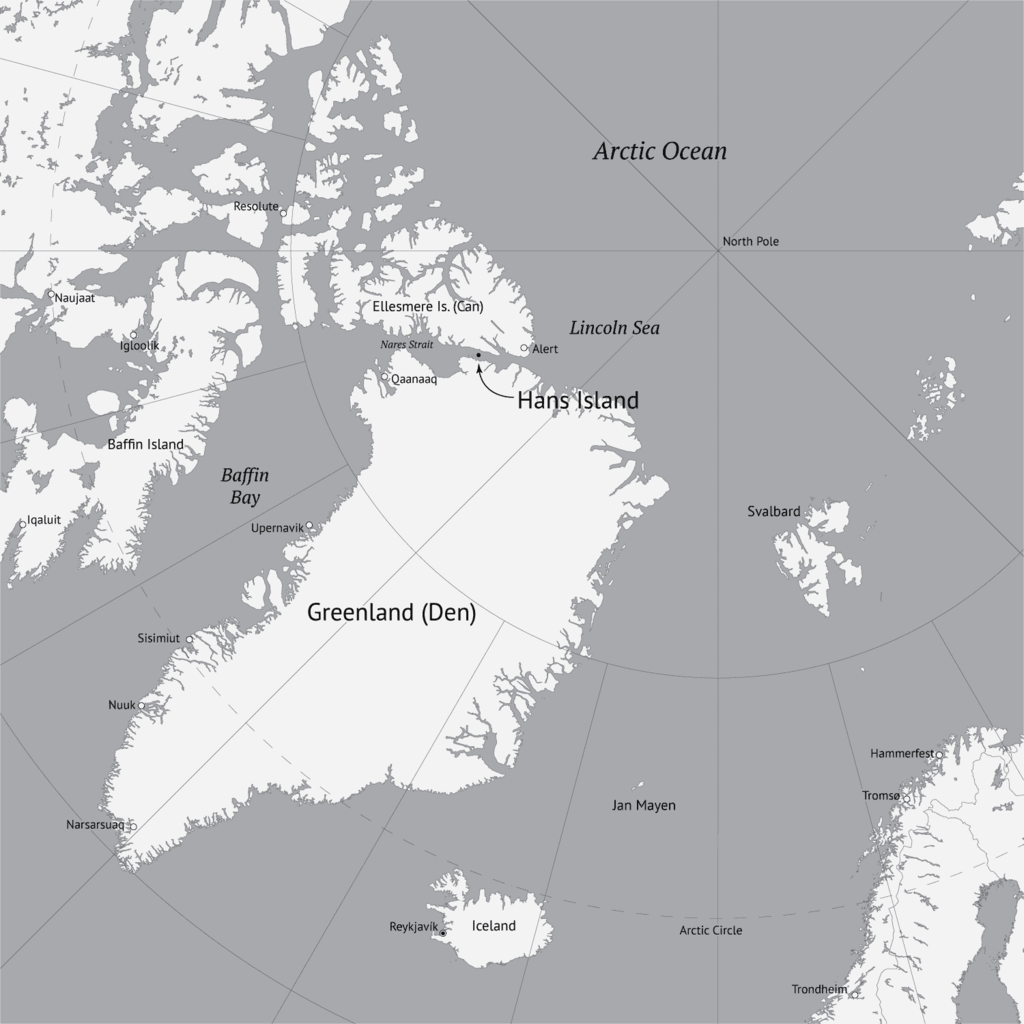

Image of Hans Island
Google Map:  Hans Island 
Google Earth: Hans Island

Note that the island is nowhere near Denmark or Britain, so no legitimate reason for those governments, or their subsidiaries/derivatives, to have title claims.

If you look via Google Earth and look at the earth from the North Pole, you can see how there is a claim that this has something to do with Russia.

There is that phrase: "unihabited".

This is what Europeans look for.  It is a reminder that the "Doctrine of Discovery" and "terra nullius" are still current concepts for Europeans.  This is the notion that if a thing (which until recently included people) was not already "owned" in a Roman/European sense, then it could be claimed to be owned simply through seizure.

European notions of properly grant exclusivity, but without any responsibility.  Once "owned", the thing can be harmed or even destroyed without any responsibility to others (human, non-human living beings, differently animated beings).

When Europeans first started to visit this continent, which the peoples near where I live call "Turtle Island", they didn't recognize the people here as civilized and had an unwillingness to even treat them as humans. When Samuel de Champlain, a subject of the French kingdom, first came across a citizen of the Haudenosaunee in 1609, the Haudenosaunee Confederacy had already been an an advanced participatory democratic league of 5 nations possibly since 1192. While the Europeans lacked evidence of their odd claim to being more advanced in social sciences, they did have more advanced weaponry.  Typical of the thinking of Empire builders, might was believed to be right. They use their savagery to claim supremacy and "civilization".


I believe continuing to use this less advanced European way of thinking in this case makes no sense.

Apparently the concern is that Russia might claim ownership through seizure, so British North America (Canada) and Denmark jointly seized the land for themselves as they already made odd claims to neighboring lands. The assumption in all this European Supremacist thinking is that it is legitimate for any European government to lay exclusivity claims based on seizure, even to lands quite distant from Europe.


Europeans are constantly feuding or at war with each other. Even though "might was believed to be right" in the European seizure of this continent, somehow Russia (also part of Europe) doing the same thing to a much smaller area currently called Ukraine that was fairly recently part of the Soviet Union is supposed to be automatically understood as wrong.

Apparently the sovereignty of Europeans we are supposed to like is good, but the sovereignty of non-Europeans we are blindly supposed to ignore.


The correct thing is for the International community to protect further land outside of Europe being claimed to be controlled by European governments based on their uncivilized notions of seizure based exclusivity. It is the people and other more-than-human relations with connections to the lands which have a motivation to steward the lands which should be protected.

What is needed is for Indigenous peoples of the polar regions to be granted sovereignty from European governments in the south (especially those operating outside of Europe).  There are agreements to disallow any foreign government to claim Antarctica, and something similar should be done with the Arctic.

In the case of what Europeans renamed "North America", it would be the beginning of allowing the True North to become Strong and Free again -- without being subjugated to European dominion.

Starting with Inuit Nunangat 

What is needed is peacekeeping to protect the land from European ideologies (whether from Eastern or Western Europe), not further land seizures by Europeans.


Saturday, March 26, 2022

Discussing: How Canada Will Fall.

I added the following as a comment to a YouTube video.  I find it interesting and I learn from people who I wouldn't normally hear from, and who have ideas ideas I don't agree with.

For a different take that is closer to my own thinking, check out MEDIA INDIGENA : U.S.A. R.I.P. ?


Interesting ideas, but I think there was a core issue not included.

Canada is a Constitutional Monarchy, meaning the constitution which was passed by British (11 British North America Acts, and then the Canada Act 1982) are a stand-in for a monarchy.  This isn't how Canada describes it, and it claims it is more like the British which has a living monarchy.  Given the deliberate modifications of the amending formula for Canada's Constitution when the British relinquished the right to change Canadian law in 1982, the Constitution is nearly impossible to change. That document is now the real head of Canada rather than the federal and provincial parliaments which are restricted by the Constitution.  Canada isn't the democracy people think it is, and the current "leadership" doesn't have the authority to change any laws they wish.


This comes into play with your discussion of the Wet'suwet'en government and their representatives, which are not European-style top-down hierarchical.  Indian Act band councils are part of the Canadian Federal bureaucracy, delegated power that the federal government is granted in section 91 of the Constitution. Section 91 grants the federal government jurisdiction over "24. Indians, and Lands reserved for the Indians."  These Indian Act bureaucracies do not have jurisdiction over land outside of reservations, or any other authority not delegated to them by the federal government, and thus do not have the legal authority to authorise the activities which some claim they have.  Some entity having an "election" is not sufficient for it to legitimately be considered a democracy -- far more is needed.

The oldest Participatory Democracy on the planet is the Haudenosaunee Confederacy, so it isn't correct to believe that there aren't working governments on this continent other than those which European settlers brought with them.  Whether other governments acknowledge their jurisdiction is separate from recognizing their existence.

For Six Nations of the Grand River, the Confederacy exists in parallel with the Six Nations Elected Council (SNEC), the latter imposed by Canada through force carried out by the RCMP in 1924.  Why?  Because that elder League of Nations went to the younger League of Nations forming in Europe to gain full membership. The European League of Nations became the United Nations, and appropriate membership of the Haudenosaunee Confederacy is still being denied.

It is the Confederacy that is a democratic government, while SNEC is merely a group of Canadian federal bureaucrats : the bureaucrats may do good work, but are not part of an Indigenous government. To understand what an Indian Act band council is requires people read the Canadian Constitution, Charter, and Indian Act.


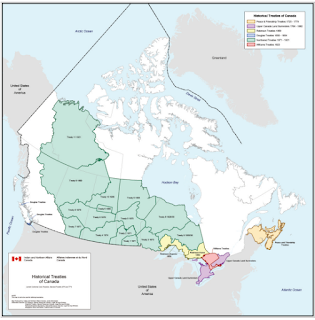
Historic Treaties Canada

Part of the 1982 changes is section 25 of the Canadian Charter which clarifies that the Royal Proclamation of October 7, 1763 is part of Canadian law, and section 35 of the Canadian Constitution that clarifies treaties as part of Canadian Law. Treaties are with nations, so that clarifies in Canadian law that Indigenous Governments must be treated as separate nations from Canadian federal and provincial governments.

British Columbia, similar to large parts of Quebec, lack treaties and thus come into conflict with the Royal Proclamation when trying to determine which bodies have jurisdiction to make certain decisions.  Again, Canada is a Constitutional Monarchy, so exactly what the Canadian Constitution says really matters.


Individuals can believe Canada is a republic, and that everything is up for the government debate, and that these legal documents don't matter. That isn't true, and that will always cause confusion and problems. I agree there is a division between the East and West on this continent, just as there is in Europe and should be expected for a continent this size.  I think it is an oversimplification to suggest the division is "left" vs "right", a concept that hasn't offered much clarity outside the French Revolution.

European settlers have had two civil wars so far on this continent, largely along north-south divisions. The separatists lost the second civil war, so that second one isn't being called a "War of Independence" by anyone. I doubt the next civil war will play out that way -- it is far more likely that east-west will be how things divide.  I have watched the growing tension over my lifetime, and I believe another civil war is inevitable -- just not the one people who believe the current imaginary line is fixed believe it will be. There are too many smug Canadians that believe what happens in the United States is somehow disconnected from them.  That British separatist/loyalist division from that first civil war is further in the distant past than people seem willing to recognize.


The fact that Canada is a Constitutional Monarchy and few Canadians are even aware of the contents of Canada's Constitution will likely cause a collapse of "Peace, Order, and good Government of Canada" (to again quote from section 91 of the constitution).  I noticed that in the "Freedom Convoy", where there was a lack of understanding of jurisdiction and the fact that the federal government had little to do with the issues people were protesting.

Wednesday, March 2, 2022

Problems I see in discussions about the Sovereignty of Nations

It is hard not to have a conversation with anyone for very long without the subject of Ukraine coming up these days.


I'm told what's happening in Ukraine is simple: Putin Bad.


When I look at the history of the area currently called Ukraine, I don't remotely see something simple.  I see an area stuck in the constant war between Eastern and Western Europe. The current borders encompass a population where the native language is Ukrainian (an East Slavic language) in the west, and a third of the population largely in the east where native language is Russian.  These divides are seen in presidential elections, as well as surveys on which economic unions the country should join.  This is a country that recently declared independence in 1991, and is not clearly pro-West, anti-East as the western media and politicians claim it is.


I am anti-war, anti-conquest, anti-colonial and anti-genocide.

I don't want any warring in Ukraine, but it is not as simple to me as it seems to others as to what the underlying cause of the warfare is.


Ottawa Siege: Trudeau Bad


I had started a series of articles discussing the Ottawa Siege, with the most recent being titled Why didn't "dictator Trudeau" just remove all mandates?

I am fully aware that the President of Russia has far more power, constitutionally and personally, than the Prime Minister of Canada.  Vladimir Putin was a former intelligence officer, and learned quite a bit about people and how to influence them.

Justin Trudeau was... umm...  a substitute teacher, who withdrew from university to seek public office. He was put into the position by a corrupt party system that wanted to launch another "Trudeau Mania" such as happened under Justin's father.

That said, I had to live through a siege on my hometown by people receiving international support for the myth that Trudeau was a dictator, rather than just being an idiot.  Some of the "Putin Bad" simplistic way of looking at things have seemed very similar.

I'm tired of this overly simplistic nonsense. Western European worldviews have a cult over individuals, which hides from most westerners the complex systemic realities of the world they inhabit.


How do people choose which attack on Sovereignty matters?


I live in on a continent that some call North America, while others call it Turtle Island.  I wrote in January my current feelings on what being a Canadian means to me, after focusing some learning on this continent for a few years.  The short-form is that Canada is not what I thought it was, and is in fact a series of governments (not a place) which is part of an ongoing act of colonialism and genocide.

Canada isn't unique. Canada, Australia, New Zealand, and the United States are collectively known as CANZUS in international circles. These are British Colonies, all of which claim independence from Britain, but where colonists greatly outnumber Indigenous peoples and where governments built on British worldviews. In the case of Canada, these governments were directly created and maintained by the British parliament, and an amending formula to allow a body on this side of the Atlantic to change the constitution was created in 1982.


I have noticed that there are many nations whose sovereignty has been subdued by another nation, but where the general population in Western European countries, and their colonies, don't pay attention.  I am not the only person who noticed this, and on social media a simple pattern has emerged.


Westerners only seem to care if the Nation whose sovereignty is being attacked is:

  • European, or European Descent -- Contrary to what some people think, North America, Australia and New Zealand are not part of Europe, but any threat to the sovereignty of these colonial governments is still considered "important".
  • Christian
  • Capitalist

Russia is only two out of three, so they are bad.  Apparently if you adopt the British/Scottish (Adam Smith) Eurocentric economic system you are good, but if you adopt the derivative German (Karl Marx, etc) Eurocentric economic system you are bad.

In the formation as it has existed in recent decades Ukraine qualifies under all three requirements, so therefore it is claimed that a threat on it is a threat to "democracy".


Threats to Democracy


When the subjects of European Christian Monarchies first visited this continent, what they found were advanced civilized nations. Some of the nations had joined to create confederacies such as the Haudenosaunee Confederacy, which had already been an advanced Participatory Democracy for centuries.


Quoting from the Onondoga Nation website:

In 1613, the Mohawks noticed people coming into their territory unannounced. The visitors had begun to cut trees and clear land for their homes and farms. They had entered the lands of the Haudenosaunee and were now occupying some of their empty rooms (land). The newcomers dressed oddly and had hair on their faces. They had iron pots and pans and had their families with them. These people needed a place to live. The Mohawks sent a runner to Onondaga to convene a meeting of the Haudenosaunee.


I regularly write about the Haudenosaunee Confederacy. From my brief on Bill C-15.

The process that eventually led to UNDRIP started in 1923. This is when Deskaheh, Chief of the Iroquois League, representing the Six Nations of the Iroquois Confederacy, left Canada to go on a mission to Geneva (Switzerland). At that time the elder league of nations (Iroquois 6 nations in 1722, and a confederacy of 5 nations possibly since 1142) wanted to address the younger league of nations (formed at the Paris Peace Conference, 1919, which later became the United Nations) to have the younger league adequately recognize the elder.
...

In response to the attempt to get appropriate international recognition for the Iroquois league of nations, the British subsidiary called Canada sent in the RCMP to depose the centuries old participatory democratic Confederacy Council. Canada installed an "Indian Act" band council which is only responsible to the Canadian crown and not citizens. This is not a Representative Government, and the ongoing refusal of Canadian governments to recognize the Confederacy Council and not fold the band council is in my mind an obvious violation of UNDRIP Article 3.


Almost 100 years later, and British allies (including but beyond CANZUS) are still blocking recognition of the Haudenosaunee Confederacy at the United Nations. Canada still refuses to recognize the confederacy as the governing body of that league of Nations.

Land theft is ongoing, as Canada and its provincial governments like Ontario believe that if they continue to put squatters on land which they don't have title over that this will eventually eradicate the sovereign nation entirely.

Watching the weak corporate-party-centric democratic institutions of Canada, it is clear these governing bodies are many generations away from having as advanced democratic institutions as what the Haudenosaunee had at European contact in the 1500's. That is if they are going to advance to being stronger democracies, as opposed to becoming even weaker over time.


Other than "stop bombing", trying to figure out what should happen in Ukraine seems complex.  What is needed is neutral third parties to get involved to help Ukraine. I am aware there is a good relationship between the Ukrainian people and several of the Indigenous peoples of this continent, but see no helpful role for excessively biased European governments or their colonies.


What Canada should be doing on this continent is far simpler, and there have been a stack of commissions and other reports over decades (longer than Ukraine has been independent) giving the Canadian governments blueprints.


Canada fully recognizing the elder democracy of the elder League of Nations seems obvious, as well as transferring all assets and financial transfers currently received by the imposed Indian Act band council bureaucracy. Then there is the matter of all the trust money which Canada "borrowed", and should get onto a payment plan to return with interest.

Six Nations of the Grand River understands that Canada does not have enough money to bring historic land issues to resolution under the existing land claims policies. 
This booklet is an explanation of Six Nations’ land and financial grievances against the Crowns of Canada and Ontario and the need for the establishment of a new perpetual care and maintenance mechanism. A mechanism that would benefit the Six Nations People and their posterity to enjoy forever, while continuing to share the Haldimand Tract lands and resources with our neighbours.


Trade and other Sanctions

When will the trade and other sanctions against Canada finally start?

Is it really as simple as the fact that the Haudenosaunee Confederacy isn't European, Christian and Capitalist?


Saturday, January 1, 2022

What does being a Canadian mean to me?

In 2020, starting on January 7’th, there were a series of protests in solidarity with the Wet’suwet’en First Nations. At the time I did not know what was happening, and did not have a clue what people could mean by “Shut Down Canada.”

This launched a journey for me to learn more about what Canada is and is not, which corrected many myths I was told growing up.
 

1492

While there is considerable evidence that pacific islanders had been doing trade with this continent for centuries, this is when Italian Christopher Columbus is claimed to have “Discovered” what some now call the Americas. Contrary to myth he never traveled to the northern continent, even though the USA celebrates him.

It was Italian Amerigo Vespucci that is the source of the name that European colonialists called these continents.

1493

The Bishop of Rome, also known as the Pope, issued more in a series of Papel bulls where he created the “Doctrine of Discovery''. This is the offensive concept that if land was not claimed by a European Christian Monarchy, that Christians could claim it (and all its inhabitants, human or otherwise) for themselves. While this policy led to centuries of colonialism, slavery and genocide, this institution has yet to apologize or pay reparations for any of the harm it causes.

Some people are finally upset at what is now called the Catholic Church, what the original Roman Christian branch was called when other branches were formed. They are finally aware of what this institution did in Indian Residential Schools, but that is merely the surface of what this institution is responsible for.

Late 1500's and early 1600's

In the early years there was trade being done with the peoples of this land. Larger problems emerged in the late 1500's and early 1600's when Europeans started to form settlements.

The correct way to immigrate into another nation is to naturalize to the existing laws and customs. While some Europeans did that and became citizens of Indigenous Nations, most did not.

When Europeans traveled across the ocean, they brought with them a series of barbaric cultural practices and beliefs which they then fought to impose on the more socially advanced nations and peoples of these continents.

It is important to remember that the Europeans forming settlements were subjects of Christian Monarchies, while some nations as well as leagues of Nations such as the Haudenosaunee Confederacy had been an advanced participatory democracy since 1192CE. In 2022, Canada's top-down hierarchical systems of governance are still generations away from catching up.


What do I consider to be some of the top barbaric beliefs and practices that Europeans brought?


  • Religious supremacy, and with it forced religious conversion and genocide. Christians fought with other religious branches that prayed to the same God of Abraham (Judaism, Islam, etc), but did not treat as human those not of Abrahamic faiths which they called "pagans".
  • Male supremacy, also known as Androcentrism -- the notion that males should have all political power, and women should be treated as property.
  • Human supremacy, also known as Anthropocentrism - the notion that humans are above the rest of creation, and that the rest of creation only has value in how it benefits humans.
  • The notion that land is something that can be "owned" rather than "stewarded". From this grew the concept of "exclusivity without responsibility", the core of western European notions of property law.
  • The notion that descendants should inherit privileges (monetary or otherwise) but never obligations. If a grandparent or other ancestor steals something, the grandchild or other descendant believes they are owed value from that theft rather than have responsibility for reparations.
 

Late 1600's through 1700's

Spanish, British, French, and Dutch colonists came. Through the 1600's and 1700's these Europeans fought with each other for exclusive European involvement in these continents, sometimes with Indigenous Nations as allies.

While the British were the last European nation that officially remained, as all others ceded any claims to the mainland, the British settlers were divided in how much respect for their own laws and the laws of the land they were willing to accept. Lack of respect (for other peoples, for the rule of law, for international treaties and law, etc) remains a defining trait of the European involvement on this continent.


1701

Great Peace of Montreal, also known as the Dish With One Spoon treaty, included the French signing a peace agreement with the (then) Five Nations of the Haudenosaunee (Seneca, Cayuga, Oneida, Onendoga, Mohawk), as well as Anishinaabe Nations (Ojibwa, Odawa, Potawatomi, Mississauga, Saulteaux, Algonquin).

The Tuscaroras joined the Haudenosaunee Confederacy in 1722 to become the 6th Nation.

1763

After the Seven Years War (1756-1763), and the Treaty of Paris 1763, the Royal Proclamation of 1763 was issued by King George III. This established the basis for governing territories on this continent surrendered by France to Britain, as well as the constitutional structure requiring respect for treaties with Indigenous Nations.

1764

Treaty of Niagara at Fort Niagara, when approximately 2000 First Nations chiefs gathered to create a peace and friendship treaty with the British. This was intended to bring the British into normal relationship with Nations on this continent. If the British had any respect for the laws of the land or their own laws this continent would be a very different place than it is today.

1774

Additional concessions were granted to French loyalists via the Quebec Act of 1774.

1775

The British government had granted concessions to French settlers and recognized inherent rights of Indigenous Nations. The British crown also required that the colonist beneficiaries of the inter-European wars on this continent should pay for the wars.

This is all that was required for the most barbaric thirteen of the British colonies to launch a war to separate from the British crown.

The British, claiming they were protecting everyone from the British separatists in those 13 colonies, violated the Royal Proclamation through their own western expansion. This will feel ironic today given so many "Canadians" claim that the United States is "our" closest ally, when in fact Canada was largely formed through claiming that the United States was the greatest threat.

1784

The Haudenosaunee Confederacy allied with the British against the separatists that formed the United States. As compensation for the loss of land south of the Great Lakes, Sir Frederick Haldimand, the governor of Quebec, granted the Confederacy Six miles each side of the Grand River in 1784

"Canada" has been denying this grant since that British subsidiary was created, and continues its dishonest attempts to steal land and wealth to this day. (See: Haudenosaunee Confederacy Announce Moratorium on Haldimand Tract, April 20, 2021)

1812

Further disrespect by the southern separatists, although it is widely reported that after this war the British no longer felt the need to respect Indigenous treaty allies as the British no longer felt the need for military allies as they ceased pursuing disputes with the separatists.

1861-1865

Wars get named by the victor, so when a subset of the separatists tried to further separate it was only called a civil war rather than a revolutionary war.


Territorial Expansion from 1867

In 1867, a small number of white men in a white minority part of the world asked the British parliament to pass the first of 11 bills entitled "British North America Act", which the British used to manage what they branded as the "Dominion of Canada".  (Dominion inspired by the Christian Bible, with that phrase used in many places including Psalm 72:8 and Genesis 1:26-28.  Canada has never been a secular government).

The Canadian Government offers a series of maps of key points in the history of this British colony. It comes with descriptions which read as colonial propaganda, and do not match any less biased interpretation of history. Maps discuss land, but the British never had title to this land so what these maps are discussing is regions which British created governments claimed some alleged right to govern.


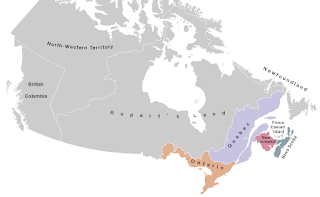
  • 1867: The non-separatist British colonies of "Canada" (Previously Quebec, and then Upper/Lower Canada), Nova Scotia and New Brunswick were joined. The colony of "Canada" was separated into "Ontario" and "Quebec". This new set of governments was formed to be part of the British Empire, effectively a corporate subsidiary of the British government.
  • 1870: Canada claims it acquires land from the Hudson's Bay Company, even though the Hudson's Bay Company did not own any land. What they owned was an exclusive patent granted by the British Crown to do business in a region. Manitoba created from this area the British called the North-West Territories.
  • 1871: In violation of the Royal Proclamation, the small number of white men who had no title to an area they called British Columbia are alleged to join the "federation".
  • 1873: British colonialists in an area they called Prince Edward Island join the "federation".
  • 1874: Boundaries of Ontario are extended into NWT. The Ontario government also provides a series of maps from 1774-1912 of regions they claim to govern.
  • 1876: District of Keewatin created within NWT.
  • 1880: British unilaterally claim the rest of the North, other than colonies of Newfoundland and those claimed by the United States and France (St Pierre and Miquelon).
  • 1881: Manitoba territorial expansion.
  • 1882: Districts of Assiniboia, Saskatchewan, Athabaska and Alberta formed out of NWT, to install settler governments to impose British rule in areas where a railway was being built.
  • 1886: Keewatin and Saskatchewan boundaries adjusted.
  • 1889: Ontario expanded yet again.
  • 1895: Districts of Ungava, Mackenzie, Yukon, and Franklin created from NWT. Athabasca and Keewatin enlarged. 
  • 1897: Adjustments of NWT district boundaries.
  • 1898: Yukon separated from NWT to become a separate territorial government. Boundaries of Quebec unilaterally extended into NWT Ungava district.
  • 1901: Yukon territory expanded into NWT
  • 1905: Alberta and Saskatchewan unilaterally imposed, granting southern colonialist control over northern district of Athabasca. The anti-democratic gerrymandering involved in this is obvious, given the so-called Alberta oil sands are in the district of Athabasca.
  • 1912: Ontario, Quebec and Manitoba imposed northward, again an obvious gerrymandering to grant southern colonial power over the north. As with Alberta and Saskatchewan, much of the resource extraction in Manitoba, Ontario and Quebec are on lands which these "provinces" were allegedly granted control over via this gerrymandering.
  • 1920: Boundary expansions into NWT formalized.
  • 1927: Newfoundland, still a separate British colony, is granted expansion into "Quebec" by the British government.
  • 1949: Newfoundland government joins the federation; some say because the British starved them out and were given no choice. (See: British North America Act 1949)
  • 1982: While not listed on the map, this is when the Canada Act was passed by the British parliament. Up until this termination of power to legislate for Canada, the British government had more control over the laws of Canada than any body on this continent. This is the point at which Canada became eligible to be considered a democracy, although I don't consider it sufficient. 
  • 1999: Nunavut becomes territory out of land previously part of NWT.


What do I take from what I have learned over the last two years?

I will use point-form


  • Canada is not what I was told growing up.
  • Canada is a set of governments unilaterally imposed on this homeland by the British to be a subsidiary of the British Empire and promote British laws and worldviews.
  • I am not British, and I don't live in Europe.
  • While my Irish, Scottish and French ancestors have been treated very badly by the British (and those who assimilated and became loyal to the British), that does not allow me or other non-Indigenous people to claim to be victims of colonialism or British conquest on this continent. (See: A call to action for fellow French descendants in "North America")
  • I do not have to be stuck in the past, and can move beyond the fact that I am a descendant of European colonists.
  • If I am not Indigenous, and not fighting for Indigenous Rights, then I am complicit with the ongoing violation of those rights. It doesn't matter when my ancestors immigrated and didn't naturalize to a domestic Indigenous government, I am still complicit.
  • I do not consider "Canada" to be the name of this place, which has retained many names since long before European contact.
  • I do not consider "Canada" to be the group of people who currently live on these lands, nor do I consider those governments to be democratic.
  • Canada is not a protector of human rights and democracy, but is guilty of ongoing genocide.
  • I do not have to adhere to what I now consider to be the barbaric cultural practices that European colonists brought with them. I can instead reject them, and politically work both as an individual and a member of the larger society to naturalise to Indigenous worldviews and laws.
  • While the Canadian and Ontario governments claim me as a citizen, there is no reason for me to be loyal to them. I have loyalty to the land that has sustained me my entire life, and the peoples who have stewarded these lands for thousands of years.
  • The institution of the Monarchy (British Monarchy, Canadian Crown, etc) has many things it should be held accountable for.
    • I reject the rebranding of a racist, colonial and genocidal institution that has existed since the 8'th century which now markets a claim to have "values" similar to that of a an idealized "family".
    • I will not mourn the death of any member of the so-called "Royal Family"

2024 update


Two additional points need to be added. I don't only apply these to the Dominion of Canada, but also other government entities:

  • While I believe in the "right to exist" (as such) of a peoples (see Genocide convention), I do not believe a government has a "right to exist".
    • If there is a conflict between the Rights of Indigenous Peoples, including self-determination and LandBack policies, and the interests of the Canadian Government, then it is the Rights of Indigenous Peoples and their self-determined governments that must prevail.
  • I do not believe a government has a "right to defend itself" against existing peoples (not individuals, but peoples -- which includes descendents) who were on that land prior to the forming of that government.
    • If a government believes that genocidal policies, including forced migration (generating refugees, Canadian decided boundaries of insufficient size "reservations", etc), are required to maintain "stability" of that government then that government can not be claimed to be an example of self-determination.
    • I do not recognize any alleged Canadian "right" to protect itself against First Nations or Innuit peoples, including but not limited to any enforcement/incarceration/etc relating to an injunction process from a Canadian court  applied to people defending the laws of their own lands.


Monday, June 21, 2021

Has the Green Party of Canada abandoned the Global Greens Values? And why Zionism keeps cropping up.

A cartoon at the top of a National Post article explains quite well what has gone wrong with the Green Party of Canada, but for the opposite reasons than the journalists are suggesting.

I was an active campaigner for the Global Greens movement within Ontario and Canada in the 1990's, hosting websites, and doing pretty much everything short of putting my name on the ballot. I've lived in Ottawa since 1987, and felt it inappropriate to parachute elsewhere or put my name forward as a uni-lingual anglophone. Several of my bilingual friends have had their name on the ballot.

In a culture that valued such things I might be considered a community elder and knowledge keeper of the movement from that period. Given we don't live in such a culture, I'm being told by Annamie Paul supporters that I'm just an "angry white man".


If you look at the Global Greens Values, it includes Participatory Democracy. This means that the Green Party Leader is supposed to act exactly as described in the cartoon: to be a spokesperson for the democratic participants and not be promoting her personal views above others.

Until recently the Green Party had 3 elected MPs, who need to be understood as the democratic caucus that directs any bureaucrat operating outside of parliament. This includes Annamie Paul who was only "elected" by political tourists who voted in a contest external to parliament.  She is not an elected parliamentarian, and thus her opinions on policy don't matter any more than any other unelected member of the party.

Her job is to support caucus members, never suggest a gag order, and never to allow her personal views to conflict with democratically established party policy and especially never conflict with elected caucus members.

The fact that Annamie Paul didn't do her job correctly forced one of those caucus members to cross the floor. Floor crossing is exactly how you hold otherwise unaccountable parties to account, which is the direction that accountability should work. Party bureaucracies should NEVER have the ability to hold caucus members to account.

In a healthy democracy political parties, if they exist at all, exist at the pleasure of caucus members and not the other way around.


I was technically a Green Party of Canada member during the last "leadership race", and was sent a ballot. Since none of the caucus members put their name forward I didn't vote.  None of the people I consider to be legitimate possibilities to be leader in a participatory democracy were on that ballot.

Gender, race and religion.


For those who want to claim this dispute is about gender, race or religion I want to point out some important details.

  • Jenica Atwin
    • Is a woman
    • Stepfather is Ron Tremblay, the Wolastoqewi Grand Chief. (see some language classes).
    • Married to Oromocto First Nation band councillor Chris Atwin and has two sons.
    • Is technically not Indigenous to this continent, but is as close as a person without Indigenous ancestry can currently get. If Canada wasn't blocking self-determination of Indigenous nations, who knows what would have been possible.
    • Her views on what is happening in Palestine is consistent with the majority of those Indigenous to this continent.
  •  Annamie Paul
    • Also a woman
    • Is visibly BIPOC
    • Converted to Judaism in 2000, the religion of her husband and also two children. Judaism and other Abrahamic/Semitic religions (Christianity, Islam, and other factions) are indigenous to Palestine, but not to this continent.
    • Her views on what is happening in Palestine is consistent with the majority of European colonizers on this continent.


What is Democracy, participatory or otherwise


If people want to learn about Participatory Democracy, and democracy in general, Europe and its colonies are not the best source.

The Haudenosaunee Confederacy has been a participatory democracy for possibly a thousand years, while Britain and Canada have been eligible to be considered less advanced hierarchical (derived from feudalism) representative democracies for less than 100. Britain didn't become what we would recognize as a democracy until 1928. Canada didn't become eligible to be considered a democracy until the UK passed the "Canada Act" in 1982. Prior to the coming into force of that Act, the UK parliament had more influence over the laws of Canada than anyone on this side of the Atlantic.


Typical of anti-democratic Canada, the government sent in the RCMP to depose the Haudenosaunee Confederacy Chiefs Council (spokespersons, not European-style feudal lords/dictators) in 1924. Canada unilaterally installed an Indian Act Band Council bureaucracy which is responsible to the Canadian Crown and not citizens. Band councils are not responsible governments -- Colonial Canada opposes responsible governments.


If Canada supported democracy and human rights, as it claims in its widely distributed propaganda, it would restore proper relations with the Haudenosaunee Confederacy Chiefs Council and disband its imposed Band Council bureaucracy. Canada would honour the Haldimand Tract Moratorium, and stop arresting land title holders for protecting their land, and even arresting journalists for reporting on Canada's unlawful activities.

Zionism


There is a long history behind this. While Zionism is generally considered to have been founded in 1897, it is what happened a few decades later that needs to be understood.

When the Christians of Europe and its colonies wanted to get rid of Jewish people in the 1930's and 1940's, a few different strategies emerged.  The German solution became known as the Holocaust, and the British solution became aggressive Christian support for Zionism (Let Jewish people live, just not here).


For further context:


As of this moment indicates:

  • 2,173,180,000 Christians (31% of world population), of which 50% are Catholic, 37% Protestant, 12% Orthodox, and 1% other.
  • 1,598,510,000 Muslims (23%), of which 87-90% are Sunnis, 10-13% Shia.
  • 1,126,500,000 No Religion affiliation (16%): atheists, agnostics and people who do not identify with any particular religion. One-in-five people (20%) in the United States are religiously unaffiliated.

Islam, like Christianity, are Abrahamic religious splinter groups, which together with Judaism (which due to less colonialism and conversion, only represents 0.2%) represents nearly 60% of the global population. Abrahamics splinter themselves further into Catholic, Protestant, Orthodox, Sunnis, Shia , etc, etc.


The political trick that is regularly used is that in a region where one of these splinter groups is dominant, others will be oppressed by that dominant Abrahamic group. Given the impact globally of colonialism and conversion (regularly forced), focusing on uplifting Abrahamic religions oppressed by other Abrahamic religions only gives more power for Abrahamic religions to maintain their status as oppressors.

People who want to know where the opposition to LGBTQ communities, misogyny, and human superiority (anthropocentrism, at the heart of global climate change and many other critical global problems) comes from should take a close look at the book of Genesis. Contrary to those who are playing the Abrahamic branch-name-game, these problems are in all Abrahamic religions and not only the one that in any region is being claimed to be the "bad branch" while trying to uplift other Abrahamic branches.


Hindus represent the 4'th largest grouping. Hindu is a name that was given to Indigenous peoples of India when foreign religious colonizers came to the subcontinent. The occupation by the Islamic Mughal Empire was followed by an occupation by the Christian British Empire.

There are several other Indigenous religions of India (Sometimes called Dharmic religions) including Hinduism, Buddhism, Janism and Sikhism. As with Turtle Island (what the peoples near where I live call this continent), Abrahamic religions are the religions of the colonizers and oppressors.


Our direction should be decolonization if we want to protect the oppressed from the oppressors. The Standard Abrahamic trick of "look, over there, an Abrahamic religious group being oppressed", never mentioning that it is nearly always by another Abrahamic faction or by a group trying to protect themselves from Abrahamic oppression, only furthers their goal of colonization.


What Christians did to Jewish people in Europe in the 1940's should have been followed by aggressive removal of the political power of Christianity and other Abrahamic religions in Europe and their colonies. That is not remotely what happened, and the problems continue. The Christians yet again created a "not me" title to point to, and continued with their activities. Genocide against Indigenous peoples is ongoing on Turtle Island, only reduced to a rate that won't get noticed in the same way it was in the 1940's in Europe.


Palestine was under British Christian occupation, so along with other members of the British Empire that had control of the newly formed United Nations they partitioned Palestine as part of the Christian Zionist "solution" to what European Christians considered "the Jewish Problem".


Britain partitioned both Palestine and India in 1947, and the fallout of those partitions are ongoing long after the British "officially" left.

It is hard to estimate how many people died due to India's partition, but 200,000 to 2 million deaths 10 to 20 million displaced is one set of estimates. The British murdered more directly during the occupations. Add the between 5 and 6 million Jews that European Christians murdered, and how many non-Christians were murdered on this continent -- but Christian Colonial Canada doesn't talk about any of these atrocities in these terms and always tries to point elsewhere.


The grassroots Green Party membership position on what European Christians have caused in Palestine is the more globally valid position.

It is not, however, compatible with the views of colonial British North America. It is something which the Green Party should learn to avoid discussing, as any substantive conversation about Zionism in Canada will have a huge and well funded backlash.


Saturday, May 15, 2021

Debate at Senate, and why not amend Bill C-15 to give definition to FPIC?

I have been watching the debates on C-15 in the House of Commons and the Senate.

Click "show sittings" on the different stages of the bill to read transcripts or watch video.  Please ask if you have never used this site, and have questions.

Some of the most interesting discussions are happening at the Standing Senate Committee on Aboriginal Peoples.

Study dates so far (click on webcast image to watch video):


Most of the witnesses have been Indigenous.  They represent a wide variety of Indigenous perspectives from coast to coast, and into the north.

Most want the bill passed quickly so this policy won't be delayed again as happened when the bill had the C-262 number. This includes some witnesses that submitted amendments to the House of Commons that were not included.

Some witnesses have amendments that are a condition for their support, and a few want the entire process scrapped and start over.

Listening closely to the testimony, the primary division is what I've observed over the last few months of debate on social media.

  • Those who believe that C-15 is a government initiative, oppose it because the government is untrustworthy.
  • Those who believe this is an Indigenous initiative exerting pressure on Canada, support it because the government is untrustworthy.


I would have to listen to the many hours of testimony again, but I don't remember a single Indigenous person offer an opinion that suggested they trusted the government of Canada. This is regardless of which political party is in power, as this isn't a recent or a partisan issue.

I think it is important for fellow settlers to watch these videos, and listen closely to learn a more honest version of Canada.

See also: Who is, and isn't, behind UNDRIP and Bill C-15 in "Canada".


There is one common question/statement made by settler special interests I want to address.

Why not amend C-15 to give definition to FPIC?


The rhetoric around this question is ...ummm... interesting.

Some in the House of Commons and Senate will talk about the "mixed messages" around the Coastal GasLink pipeline, and how most "elected" chiefs supported it while "hereditary" chiefs did not.  They are trying to imply that democracies wanted it, but scofflaws were opposed.


All the bills I've seen to start the process to change laws to conform to UNDRIP include a verbatim copy of the declaration as passed on 13 September 2007  (Example from the version of the bill tabled in 2008 by Tia Keeper).


UNDRIP articles include:


Article 3
Indigenous peoples have the right to self-determination. By virtue of that right they freely determine their political status and freely pursue their economic, social and cultural development.
Article 4
Indigenous peoples, in exercising their right to self-determination, have the right to autonomy or self-government in matters relating to their internal and local affairs, as well as ways and means for financing their autonomous functions.
Article 5
Indigenous peoples have the right to maintain and strengthen their distinct political, legal, economic, social and cultural institutions, while retaining their right to participate fully, if they so choose, in the political, economic, social and cultural life of the State.
Article 6
Every indigenous individual has the right to a nationality.


The so-called "elected" band council system was created by colonial Canada as a deliberate way to disrupt existing Indigenous responsible governments.  Band councils are not examples of responsible governments, and are bureaucracies responsible to the Canadian crown.  The notion that just because there is an "election" that the body must be democratic is false.


I regularly write about how Canada sent in the RCMP to depose the centuries old democratic Haudenosaunee Confederacy, and impose a "band council" that is only responsible to the Canadian Crown.

See also:


The question of who represents Indigenous peoples, and thus who can give consent, was disrupted by Canada.

While there are examples such as the Haudenosaunee Confederacy where the centuries old participatory democracy remains intact, and can take over from the "band council" once Canada properly recognizes it, this is not the case in other circumstances.  Colonialism and ongoing genocide has a huge impact on governance systems, and there are cases where all that remains is the "elected" band council.


The idea that Canada in consultation with Indigenous peoples can or should define FPIC at this point is to ignore (and seek to benefit from) the damage that Canada continues to do.

If the complexity of consent causes some business projects to be denied, then that isn't a bad thing.  That might cause industry to recognize an urgency and also push Canada to finally adequately resource the work required to move forward on the above UNDRIP articles.

It is the Canadian government that created these problems, and it is the Canadian government that needs to fix them.  If anyone has any problems with the uncertainty, please apply pressure against the Canadian government to fix their mess.


Some settlers (British loyalists, or something else) have even asked whether one chief along a pipeline saying "no" is a "veto" against the interests of all the other chiefs?

Switzerland and Austria are landlocked countries in Europe.  Nobody would ask if Switzerland wanted to put in a pipeline whether Germany or Italy had a "veto" in not letting Switzerland put a pipeline in another country.

Built into this question is their belief in the supremacy of the British created colonial governments of Canada, and the idea that these governments should be able to "veto" anyone else's views and impose their own.


I for one am not a British loyalist, and do not presume the supremacy of any of the British created colonial governments.  Canada should not have a "veto" when walking into negotiations with other nations they have treaties with.  This is especially true of places like BC and Quebec where Canada has been so disrespectful of human rights they didn't bother with a treaty.

Canada should never believe they don't need to get consent, and can just impose their will (with the barrel of a gun) if they don't always get their way.

In one case someone actually said out loud that Canada should impose restrictions on the structure of the self-governments that Indigenous nations are allowed to create for themselves.

Yes, that is something else.


Wednesday, April 14, 2021

Brief to The Standing Committee on Indigenous and Northern Affairs, for the study of the Subject Matter of Bill C-15

I sent in a brief to the committee for their study on March 25'th (PDF), but it was a bit too long so was asked to send in a more brief brief on April 12'th (PDF, via OurCommons.ca).

I'm merging the footnotes from the earlier version for this blog.

Introduction


This is my ( My name is Russell McOrmond. Full contact information is at http://www.flora.ca/#contact ) first submission to parliament on this area of policy as I previously focused on technology law. I wish to offer myself as an example of a privileged white male who for most of my life was unaware of Canada's record on human rights. I believed what I was told, and now wants what I was told to match Canada's actions.


European worldviews were embedded within the UN's conceptualisation of Human Rights as encoded in the Universal Declaration of Human Rights. I do not believe UDHR was ever universal, and consider UNDRIP a critical step in that direction.


I am aware of opposition to UNDRIP as adopted by the UN General Assembly in 2007, as well to Bill C-15 which is the current incarnation of a bill to affirm and update domestic law to reduce violations of the rights of Indigenous Peoples. I disagree with this opposition.

My transition


I was born in 1968 in Sudbury, Ontario, moved to Ottawa to attend university in 1987, and have lived here since. (I acknowledge I have lived on land of an Anishinaabeg nation my entire life, but have never been given the opportunity to be naturalized.)


In 1990 I heard about the "Oka Crisis". I believed if the Canadian governments sent in the police and military that the "protesters" must have done something wrong. Over the years I have learned to question these assumed "truths". I initiated self-directed anti-racism training starting in the summer of 2020. I better understand what happened during the 1990 Kanesatake Resistance, and recognize it as one of many high profile examples of Canada violating the human rights of Indigenous peoples.

(I wrote an article titled "Help stop overt racism and white supremacy in Canada!" that discusses additional examples https://mcormond.blogspot.com/2021/01/white-supremacy.html )

Criticism: Bill proceeding too quickly


The process that eventually led to UNDRIP started in 1923. This is when Deskaheh, Chief of the Iroquois League, representing the Six Nations of the Iroquois Confederacy, left Canada to go on a mission to Geneva (Switzerland). At that time the elder league of nations (Iroquois 6 nations in 1722, and a confederacy of 5 nations possibly since 1142) wanted to address the younger league of nations (formed at the Paris Peace Conference, 1919, which later became the United Nations) to have the younger league adequately recognize the elder.

To put this in context, this process started only 18 years after the Dominion of Canada unilaterally passed the "Alberta Act" and "Saskatchewan Act'' in 1905. This has been interpreted to impose a British governance system over areas of land which Canada had purchased an exclusive business patent for from the Hudson's Bay Company. These Acts were to split off sections from what the British had been calling the Northwest Territories.


In response to the attempt to get appropriate international recognition for the Iroquois league of nations, the British subsidiary called Canada sent in the RCMP to depose the centuries old participatory democratic Confederacy Council. Canada installed an "Indian Act" band council which is only responsible to the Canadian crown and not citizens. This is not a Representative Government, and the ongoing refusal of Canadian governments to recognize the Confederacy Council and not fold the band council is in my mind an obvious violation of UNDRIP Article 3.

We can skip to the 1940's when the UN was drafting the so-called "Universal Declaration of Human Rights" and how there was a refusal from western nations with their narrow focus on individuality to entertain the idea of protecting "peoples" rather than only "people". Grand Chief Littlechild recently discussed that process during a Town Hall on UNDRIP and C-15 hosted by Amnesty International Canada. ( https://youtu.be/IXh2--pBDdA?t=4435 . This skips to the specific section where J. Wilton "Willie" Littlechild discussed the process. https://en.wikipedia.org/wiki/Willie_Littlechild )

In 1982 the UN established the Working Group on Indigenous Peoples, the same year the United Kingdom passed the Canada Act 1982. The Canada Act, among other things, finally meant that UK law was not automatically Canadian law. The UK population being twice that of Canada had always meant that UK citizens had more influence over Canadian law than anyone actually living on Turtle Island. While new UK laws wouldn't automatically be Canadian law, the BNA and Canada Acts had already imposed a system based on thousands of years of foreign British history onto Turtle Island.


I don't expect anyone was surprised which countries voted against the UNDRIP resolution in 2007, 84 years after the process began. It is the 4 British colonies where non-naturalised settlers greatly outnumber Indigenous peoples: Canada, Australia, New Zealand, United States (collectively known as CANZUS).

These colonies are where the human rights violations against Indigenous peoples have been the greatest over a longer period of time. I put this area of policy into an important context with the following percentages of Indigenous populations remaining in regions currently under active colonialism. Colonialism almost inevitably leads to genocide. ( Dr. Kim TallBear indicates we should use the UN definition of genocide, and recognize Indigenous Peoples "Very Clearly" are suffering genocide.  https://www.facebook.com/407570359384477/videos/2226217140832714 )

Uyghuristan
(Xinjiang, means 'new frontier' in Mandarin) 

43.6%

Canada

5%

Australia

3%

New Zealand

17%

United States

2%


Given the Government of Canada was created 154 years ago, and for more than half that time this policy has been discussed, nobody can claim that this policy was "rushed".

Criticism: Canada can't be trusted to honour UNDRIP

I understand this criticism, but still disagree. Canada has been violating human rights since it was created by an act of the British Parliament in 1867. Passing Bill C-15 alone will not stop this ongoing violation.

Concurrent with debating Bill C-15, Canada is engaged in further violations of the Rights of Indigenous Peoples. This includes basic Article 3 right of self determination with Canada trying to restrict Jordan's Principle eligibility to a "status" criteria that is determined by Canada and not Indigenous peoples. I consider what is happening near Caledonia with "1492 Land Back Lane" to include violations by Canada and Ontario of several UNDRIP articles. This document could never be considered a "brief" if I tried to list all the violations of human rights by various levels of Canadian governments that I am aware of.

The hardest concept to understand with anti-racism is the difference between individual race based prejudices and the systems of racism ( The author that allowed me to best understand the difference was Ibram X. Kendi, primarily through his book Stamped from the Beginning. https://www.ibramxkendi.com/stamped-from-the-beginning ). Systemic racism isn't a system which contains racist individuals, but is a system which is itself racist. These are systems where "not racist" individuals will still carry out racist acts simply by obeying the law or following normal procedures or practices.


I don't think of Canada as a place, as this place had names long before Europeans visited.

I don't think of Canada as a group of people. At no time in the past did the inhabitants of this land come together and decide to be called Canada or to form the Government of Canada. A small group of white males in a white minority region of the world decided to ask the foreign British government to pass a law. That law created a subsidiary of the British government, created to be part of the British Empire.

What this means is that Canada is a system, and any attempt to make that system less racist must be focused on that system. Whether specific individuals can or cannot be trusted is entirely separate from the system. Far too many people are focused on individual people in indicating that those people cannot be trusted -- individuals following a system and believing they are individually "not racist". This regularly leads to the logical fallacy known as the Association fallacy (Guilt or honour by association, an ad hominem fallacy).


This bill needs to finally receive Royal Assent, after many incarnations being tabled since 2008 ( I discuss the dates within "How I analyse and why I support Bill C-15, the UNDRIP related bill" https://mcormond.blogspot.com/2021/01/c15-undrip-analysis.html ). This last 12 years is sufficient time for debating the exact wording of the bill. Anyone who has been paying attention to this issue at any level has had time to provide input.

Receiving Royal Assent is not a "Mission Accomplished" moment for Justin Trudeau or the Government of Canada. It is a critical but early step in recognizing the truth about Canada, and work that must happen long before we can start reconciliation. Truth comes before reconciliation, and it quickly became obvious to me while studying this area of policy that Canada and most Canadians have not yet come to grips with truth.

Criticism: Free, Prior and Informed Consent (FPIC) is too vague


Similar concepts to "Free, Prior and Informed" exist in contact law (mutual consent, contractual capacity, etc). You can't hold a gun to their head or force someone to sign, can't change the terms after agreement, or lie to one of the parties about the contents of an agreement (translations, etc).

What this really comes down to is that some people believe it is legitimate to debate whether there should be a need for consent for activities which are otherwise considered a violation of human rights.


I know of no other human rights that are so callously debated. Nobody would be asking if a "right to life" represented a "veto" for those who wanted to murder (especially for profit).


Is it a "veto" to disallow slavery or torture? What about narrow western notions of property in UN UDHR article 17 (western notions of property being exclusivity without responsibility)?

The context I have heard this debated most often is from individuals or politicians representing industries which wish to continue to violate human rights for profit. I find it disgusting that this conversation persists in the Canadian government, parliament and media.

Criticism: Indigenous Peoples should be consulted on C-15 and have FPIC

UNDRIP was primarily authored by Indigenous peoples, and wasn't authored by Canada. Bill C-15 itself regulates Canada, future Canadian governments, and not Indigenous peoples ( I offer a more extended version in https://mcormond.blogspot.com/2021/02/undrip-regulates-canada.html  ). This criticism is largely an example of the Association fallacy.


I believe this relates to the confusion about what Canada is (a system), where there is a belief that if the Government of Canada (parliamentarians) tables a bill that it must be in the interests of Canada (the system).


Canada markets itself domestically and internationally as a leader in protecting and promoting human rights. Canada rejecting international human rights norms would cause people to recognise this as a myth. Canada really doesn't have a choice if it wants to avoid sanctions against it for being a perennial violator of human rights. While Canada and the USA have Magnitsky legislation, the lack of understanding of what CANZUS countries are doing will likely surprise some when similar legislation in other countries is finally used to sanction Canada.

It makes perfect sense for Indigenous peoples globally to be critical of Canada for delaying affirmation and the process to correct the large body of "domestic" laws which encourage/induce human rights violations. It makes no sense to oppose the bill once it is understood that C-15 is not something the Canadian government wants to do, but is something that due to international pressure Canada must do.

Bill C-15 does not "implement" UNDRIP, the way most people understand the word "implement".

The bill affirms UNDRIP applies in Canada. This is an additional clarification of the status-quo, given UNDRIP should be understood to already apply once it was officially adopted by Canada in May 2016. Embarrassingly, Canada was the last of the 4 original CANZUS objector countries to finally adopt UNDRIP. (Australia 2009, New Zealand 2010, United States 2011)


Secondly, the bill creates a process to amend laws which is "in consultation and cooperation with Indigenous peoples". It is not in passing C-15 where FPIC might be violated, but with a dishonorable government carrying out the process in a way that gets this aspect wrong. This isn't a logical reason to oppose C-15 as this is not where the problem exists, but a reason to be aware that passing of C-15 is the beginning and not the end of a process.


Every time a government representative claims that C-15 "implements'' UNDRIP "in accordance with the Canadian Constitution" they are generating opposition and making it harder to move forward.


Canada is in violation of human rights prior to the passage of C-15, and will still be in violation after. Passing C-15 is about a process, and is not a magic wand that will immediately stop Canada from violating human rights.


Several government representatives discussing UNDRIP in context of Section 35 of the Canadian Constitution speak in a way that suggests the reverse of the non-derogation clause in Bill C-15. That clause is clearly intended to be read that C-15 can not be interpreted in a way to reduce any rights affirmed by Section 35, while UNDRIP is clearly intended to articulate new rights beyond Section 35. Language used by government representatives are being interpreted to mean that UNDRIP is subservient to Section 35 - that the only UNDRIP rights that remain when "domesticated" are those already confirmed by past Section 35 interpretations.

The constant use of the "implement" language, as well as confusion around the relationship between UNDRIP and Section 35, has caused many Indigenous peoples to oppose Bill C-15 due to the mixed messages the government is sending. I'm not sure if generating confusion and opposition is a deliberate action on the part of the government, or part of the ongoing mishandling of this area of policy.


Criticism: Provinces, municipalities, or business sectors should be consulted on C-15 and have FPIC


No.


Trade and other sanctions for ongoing human rights violations will be against Canada. Internal jurisdictional issues may be important to Canada, but are irrelevant at an international level.


This is true in the context of UNDRIP as well as the nation-to-nation relationships between Canada and First Nations. UNDRIP, as well as Section 35 of the Canadian Constitution, must always be understood to be at the national level, above the provincial level and beyond internal Canadian jurisdictional debates.

Provinces are creatures of the Government of Canada and/or Britain and should not have a say in whether they will honour internationational human rights instruments. Municipalities are provincial corporations, and as with any other corporation should simply honour international human rights norms or be held fully accountable for any non-compliance. Each level of government should be launching their own process to modify their own laws and procedures to come into compliance with international human rights, and not in any way slow down the federal process.


Businesses which have been profiting off violating human rights should be brought into compliance, or possibly folded as a consequence of continuing for-profit violations of human rights. They should be treated as organized crime. I noticed the witness list and am not sure how organisations such as the "Canadian Association of Petroleum Producers" could have anything fruitful to add to this human rights discussion.