Showing posts with label religion. Show all posts

Thursday, November 30, 2023

Is there a religious war in Western Asia? It certainly isn’t a war between two “countries”.

I want to encourage people to gain the context of these events rather than believing what happened this year is new or surprising.

This is what I do: I analyze policy like I analyze software, and look for interactions between policies as well as operating systems and other aspects of the environment. I don’t blindly accept what I’m told by marketing material, but analyze the actual policy/code. I look for logical fallacies in claims being made, and try to figure out the truth under those fallacies.
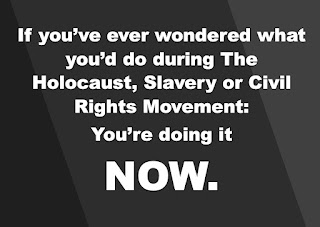
A previous LinkedIN connection wanted to talk about “Hamas” and the most recent skirmish, rejecting that there could be any context required to understand what was happening. They were responding to a post that suggested, “If you have ever wondered what you would do during The Holocaust, Slavery, or the Civil Rights Movement: You’re doing it NOW.”

The previous LinkedIN connection posted: “What do you believe the appropriate response to the Hamas war crimes, as you admitted they are, should have been?”

This is a pretty typical loaded question logical fallacy.

This is the nature of most discussions on this topic: loads of logical fallacies. There is a desire for this to be black-and-white (it isn't even close), that it is clear what "started it", for there to be "two sides" to pick from, and so-on.


It is possible to recognize and mourn the deaths of people on all sides of today's borders between land declared the jurisdiction of a UN created UN member (Government of Israel) and those in the Gaza Strip and West Bank where self-determination has been blocked by external forces for over a century.

Any attempt to "two sides" discussion of this centuries-on Holy War is false, as this is not a "war" between two countries, and has been ongoing since long before “Hamas” was founded in 1987. While I strongly condemn the violence from all belligerents, I rightfully hold UN member states – especially those which claim to be democratic and protective of human rights – to a higher standard than angry mobs or terrorist groups.

I am aware that the “Change and Reform list“ that “Hamas” campaigned within was “elected” in 2006 under a Plurality Block Voting system. I have been critical of claims that brand-centered “elections” are representative of populations for a very long time. However, to claim that Gaza is currently under a democratic government, or that residents of that region (not “citizens”) should be held accountable in the same way for actions carried out under the “Hamas” brand as citizens of a “democratic” UN member state branded "Israel", is a total misrepresentation of reality.

I’m not a fan of the electoral system or other weak democratic institutions of Israel any more than I'm a fan of Canada’s weak democratic institutions. However, I do not believe this is about Benjamin Netanyahu or any other individual. If Israeli citizens feel their government doesn’t represent them and is inducing violence and making them less safe, they have mechanisms to fix that which residents in regions that don’t have an alleged “democratic” government claiming jurisdiction do not. If citizens of other nations recognize the Israeli government is in violation of International Law, they can push their governments to hold the Government of Israel to account (including holding governments like the US, which regularly blocks accountability, to account for regularly disrespecting International Law).


The previous LinkedIN connection suggested this is about “Radical Islam”. The Government of Israel was created via “Radical Zionism” and “Radical Christianity”. The then-Christian Empire dominated United Nations (formed 1945) created the Government of Israel in 1947 via partitioning British occupied Palestine.

We should discuss the Balfour Declaration of 1917

We should discuss the Likud Party Platform (such as from 1973) and its genocidal call for "between the Sea and the Jordan there will only be Israeli sovereignty". We should talk about Irgun/Etzel, the political predecessor to Likud, which operated between 1931 and 1949. It was generally recognized as a terrorist group before rebranding.


We should discuss how the United States (or sometimes Britain) will veto any resolutions to try to hold the Government of Israel accountable at the more modern United Nations.

We should discuss oil under the Gaza Strip.

We should discuss how Evangelical Christians believe Jews having exclusive control over that land will lead towards the Rapture / Second Coming of Christ. From that randomly chosen article: "What happens to the Jews and Palestinians is, to put it very mildly, collateral damage."

It is obvious that the United States and other parts of the Christian Anglosphere are as much a part of the violence in the region as “Jews” and “Arabs” (including Arab Jews, given those aren't distinct categories). This is not what we under Christian Anglosphere governments are indoctrinated to believe are the only belligerents.

Wednesday, March 10, 2021

Were Adam and Eve voted off the Island?

My self-directed anti-racism training brought me first to studying racism itself (a system, distinct from individual prejudices), to Indigenous studies, to worldviews, and then to religion. I have been struggling with my own relationship with religion since I left Christianity in my late teens.


The Abrahamic Origin Story

In Trans-Indigeneity, and a loss or lack of Indigeneity I referenced where/who I was from, and that the Indigenous worldviews of my peoples were long ago replaced by Abrahamic worldviews. In Is religious freedom camouflaging ongoing colonialism and empire building  I discuss how Abrahamic religions all share core worldviews, even if the various splinter groups disagree on specific details. (Christianity split from Judaism, Protestants split from Catholicism, Islam split from Christianity/Judaism, etc).

The book of Genesis writes down the Abrahamic origin story, and from this we can see the core Abrahamic worldviews.  Much of what people think of as western worldviews, including the notion that humans are separable from non-humans (animals, plants, land -- the environment, the planet, mother earth), the patriarchy, and related worldviews can be seen.


Many people globally are trying to do harm reduction in relation to these worldviews, whether that be issues relating to gender discrimination (cisnormativity, heteronormativity, patriarchy), climate change (and related environmental destruction by humans), or colonialism (and the inevitable genocide that colonialism leads to).

It has been my observation that most are uncomfortable discussing any of these issues in the context of religion, as specific interpretations of "freedom of thought, conscience and religion" suggest that questioning the impact of specific thoughts deemed religious is somehow a violation of religious rights.


While titled "The house modernity built", I believe that this is the house that Abrahamic worldviews built.


I grew up reading the Christian bible, and heard all the stories. As a quick introduction here is a short summary of the first few chapters 

  • In Genesis 1 the teaching is that humans were created in their god's image, binary male and female, and that they are to “Be fruitful and increase in number; fill the earth and subdue it. Rule over the fish in the sea and the birds in the sky and over every living creature that moves on the ground.”
  • In Genesis 2 the teaching is about the importance of Adam, and Eve as the first humans, and how their god planted a Garden of Eden for Adam, and created Eve to be his helper.
  • In Genesis 3 the teaching is about Adam and Eve being kicked out of the Garden of Eden because of what Eve (the woman) had done.  The pain of childbearing, and the idea that women should be treated by men as property are ongoing punishment for her wrongdoing.


Alternate origin stories

The author of the paper that inspired the blog article discussing my lack of Indigeneity was a guest lecturer last evening. His words offered more food to some thinking I've been having for some time.

What if Adam and Eve were just two people who didn't fit in because of their personal beliefs, and were "voted off the island" (banishment) and sent to live somewhere else?  Adam and Eve (well, most likely just Adam given their beliefs) then spun a story that became the origin story for the peoples of Judea. Those stories became the origin story for all the Abrahamic religions which continue to use conversion and colonialism to spread throughout the globe and replace other origin stories with their own.


In No Island is an Island, Vicente M Diaz included a figure describing the geographic reach of the outrigger canoe technology of his people, describing the distances that they could travel.


It is suggested that the Abrahamic teachings were first written into the Hebrew Bible in a period starting at about 1200 BCE, so within the 4 thousand years where there has been evidence of travel via the outrigger canoe.

For those people who don't love maps as much as I do, the top-left hand corner is where Judea would have been (now disputed territories between Abrahamic peoples), and the top-right hand corner is the left-foot and part of the tail of Turtle Island, the western part of an area currently called Mexico.

Columbus might have commanded one of the first ships to travel to Turtle Island carrying people with Abrahamic worldviews, and thus people disconnected from place and the peoples of that place. It is totally inconceivable to me that this voyage was the first time Indigenous peoples traveled between Eurasia and Turtle Island.

History of navigation


If seafaring navigation is of interest, as is often the case, wikipedia provides a good jumping-off point to read more. It's important to recognize that all humans have biases, and thus what is written on Wikipedia, as with all human writing, is not "objective".


Is it just me, or does that image make you think of a whale, much like Turtle Island looks like a turtle.

Saturday, December 19, 2020

Is religious freedom camouflaging ongoing colonialism and empire building?

Many people will already know the connection between Judaism, Christianity and Islam. Until recently I hadn't given it much thought.


I grew up in a Christian family.  My father was Seventh-day Adventist, my mother Catholic, and they then moved together to a United Church. I live within a Christian Country -- meaning that the Government promotes and includes Christianity within it, not that every Canadian is Christian.

When I was a child and told about Judaism, I was told that they were in some way wrong. I was too young to question, so I took it on faith along with everything else I was taught as a Christian.

Later in my youth when I was finally told about Muslims, I was told they were dangerous. I was told that "we" fought the crusades against "them" so that "they" would not kill all of "us".

As a young adult I was told I should have Judeo-Christian values, suggesting that the underlying values of Judaism and Christianity are the same and that these were all good values. I was still told that Islam was an "other".


Fast forward through much of the last 40 years, including through the increased religious tensions as fallout from September 11'th, 2001.....


I now know about Abrahamic religions, which are all a group of Semitic originated monotheistic religions that are descendants of the ancient Israelites and worship the god of Abraham.


I grew up learning about denominations of Christianity, and when you step back a bit more the differences between the various Abrahamic religions including Judaism, Christianity and Islam, have similar disagreements on the details -- but share the core across the religions.

So, why does this matter?


Before I traveled to Ireland I believed that the ongoing hostilities (including acts of terrorism) was about Catholics vs Protestants. During my visit I learned that it was a largely successful uprising against British colonialism. The remaining hostilities are localized within a small corner of Ireland calling itself Northern Ireland that is still considered part of the British Empire. Within Northern Ireland there are people loyal to Britain while their neighbors are loyal to Ireland. As a person of primarily Irish descent, I would have grown up with a different attitude towards Britain and colonialism (including what I was participating in within Canada) had I been told the truth about a variety of problems in Ireland -- including the potato famine which was largely caused by imposed food exports to other parts of the British empire. The discussion of religion appears to have been a method of distraction.


On the November 29'th episode of One Dish One Mic they interviewed Terri Monture. She was being interviewed as a journalist who is staff at the Canadian Media Guild, specializing in human rights issues. She is a Kanienkaha'keh (Mohawk) from Six Nations of the Grand River. Much of their discussion was about media in general, but the interview ended mentioning she was part of a delegation that went to Palestine in 2018.

This was the first time I had heard the conflict between Israel and Palestinians discussed as a form of colonialism. If you understand that area as being the land of the ancient Israelites, and believe that land should be returned to indigenous peoples, you are still left asking why it is only the Jewish descendants that are being allowed? Semitic peoples, regardless of which specific religious views they hold today (Jewish, Christian, Muslim or others), seem to have an equally legitimate inherent right to the land as indigenous peoples -- and yet this is not the viewpoint expressed primarily by Christian colonial nations (Europeans and their current and/or former colonies). You are claimed to be anti Semitic if you question Zionism, even though Zionism is colonialism against other Semetic peoples.


A related conversation happens in North America when discussing colonialism. While we are free to discuss the horrors in the past tense, we are not allowed to discuss how colonialism continues in the present or the involvement of Christianity in colonialism.  Most people seem to believe it was a coincidence that Christian Churches were involved in residential schools. Forcing conversions to Christianity is a core part of why the Bishop of Rome (Pope) through a series of papal bull's created the concept of the "Doctrine of Discovery" which authorized and promoted colonialism by European Christian monarchs.


Any time you wish to discuss these policies, you come up against a specific interpretation of "freedom of religion" which suggests any discussion or critique of religion is a violation of a human right.  The UN Universal Declaration of Human Rights (UDHR) Article 30 actually protects "freedom of thought, conscience and religion" which includes the right of an individual to change religion and to not have a religion.  It does not in any way allow an individual or group to impose their religion on others, or force others to live by their beliefs. In 2018, as part of the 70'th anniversary of the UDHR, an article discussing Article 30 offered many clarifications.


In the journal article Decolonization is not a metaphor, Tuck & Yang included the following passage:

The settler, if known by his actions and how he justifies them, sees himself as holding dominion over the earth and its flora and fauna, as the anthropocentric normal, and as more developed, more human, more deserving than other groups or species.

Having grown up a Christian, part of that passage sounded very familiar to me.  Genesis 1:26-28 reads

26 Then God said, “Let us make mankind in our image, in our likeness, so that they may rule over the fish in the sea and the birds in the sky, over the livestock and all the wild animals, and over all the creatures that move along the ground.”

27 So God created mankind in his own image,
in the image of God he created them;
male and female he created them.

28 God blessed them and said to them, “Be fruitful and increase in number; fill the earth and subdue it. Rule over the fish in the sea and the birds in the sky and over every living creature that moves on the ground.”


This is Genesis, the first book of the Hebrew Bible, therefore part of the Torah, also known by Christians as The Old Testament, and also inspiration for parts of the Quran.

Given this common theme between settler colonialism and beliefs embedded within Abrahamic religions, it should not be surprising that many people of spiritual beliefs indigenous to North America and/or having different relationships to more-than-humans will see these religions as part of colonialism. If every time someone discusses ongoing colonialism it is allowed to be blocked by claims of "religious freedom", then it becomes impossible to ever protect human rights.


My wife and I have subjected ourselves to watching the Roman Empire Netflix TV Series. The acting is bad, and the commentary from historians talking about how "great" this empire was makes them sound more like cheerleaders for white supremacy than scholars. The very features which allegedly made the Roman Empire "great" are the basis of worldviews which many in the world reject as part of modern-day colonialism and western empire building. Not discussed (yet?) in the Netflix series is the connection between the Roman Empire, which included Judea at the time of Christ's birth, and Christianity, which Roman Catholics claim was started by Jesus Christ.  In 313 the Roman Emperor known as "Constantine the Great" allowed "tolerance" for Christianity (Romans had been polytheist), but that 10 years later Christianity became the official religion of the Roman Empire and thus part of their empire building. In some ways the spread of Christianity and associated worldviews through colonialism and global empire building, authorized by the Bishop of Rome, can be seen as a continuation of the Roman Empire.


Is the ongoing clash between Judaism, Christianity and Islam merely a clash between colonialist empire builders? Is it a phobia or simply logical to be concerned about threats of empire building?


Have a Happy Winter Solstice!

Worldometers -- World Population by Religion

Saturday, November 21, 2020

The colour of religion and opposition to secularism.

When I think of religion and its impact on politics, I look at a few criteria:


  • Is the religion hereditary, or does it increase membership through conversion. How aggressive is the conversion, and how do they treat people who don't convert?
  • Is it an example of spirituality, or does it contain a hierarchical political force?  Does that political force have state aspirations?
  • How populous is the religion, and thus how much influence can it exert on global politics?


Only 3 religions (Christianity, Islam and Hinduism) currently have populations above 10%, and thus those are the religions that concern me the most. While it is fortunate that none of these religions have achieved 50% of the global population, it would be incorrect to think of any of these religions as minorities.


Consistent with my antiracism reading this year, I remain focused on systems.  I don't think about individual practitioners, where they live, or where their ancestors came from (and thus skin melanin). This works well for me as I have always been more comfortable thinking about systems and the connections between systems, and less comfortable with the concept of  individuality.


While these are my criteria and mindset, other people see religion very differently. They look at the race and ethnicity of the individual practitioner, and focus on that and not religious systems.


While Islam and Christianity originated in the middle east, it was Christianity that took over Europe. Judea and parts of Europe were part of the Roman empire at the time, while Mecca was within Arabia. Given the subjects of Christian monarchs were sent by the Italian Pope (Doctrine of Discovery) to colonize and convert the world to Christianity, it is now hard to clearly differentiate European worldviews or even white supremacy from Christianity.


I personally know many people of Indian (the country) descent.  When they hear critiques of "ostentatious religious symbols" they think of the turban and hi·jab, not the religious habit of Christianity or the cross.  They feel that whole discussion is only an attack against brown people.

This is a hard problem to attempt to deal with. While I see so many people being critical of those of faiths different than their own, I don't think it is correct to lump into the same basket those fighting for a separation of every church from governance.


Religious groups quarrel with each other quite regularly, and have ongoing wars.  Those who are Christian and are only critiquing non-Christians, as well as those who are Muslim and only critique non-Muslims, are on the opposite side of the debate as those of us fighting for secularism. 

Some people have been able to move beyond individuals to systems, and finally recognize centuries of harmful political influence of the Catholic Church specifically, and Christianity generally. Even as this happens, issues around race make them unable to recognize religions not dominated by white people as being a similar threat.


While I recognize this problem, I can't think of a solution.  I am aware that I will regularly be considered a racist and/or bigot for opposing religious symbols being worn by people providing specific government services.  If I went to court and saw the judge wearing a cross or hi-jab I would not consider them any more trustworthy to do their job correctly than if the judge were wearing a MAGA cap.

(leave alone any mention of a specific symbol used in various religions in India that the Germans abused in the 1930's. Few westerners are even aware of the original meaning).

Saying nothing, and allowing religion to continue to be abused to manipulate and/or dictate the politics of nations is not an option.


Thursday, November 12, 2020

Trudeau's Trumpisms: There were not fine people on both sides.

While the "very fine people" meme about Trump isn't entirely accurate, it is accurate to suggest Canadian Prime Minister Justin Trudeau is guilty of worse.  Trudeau tried to suggest false relevancy when he offensively included the suggestion that "freedom of expression is not without limits" when discussing a teacher being beheaded as an act of terrorism. Suggesting that the teacher who was murdered had any fault at all is more dangerous than negotiating with terrorists, and grants power to that terrorism. This should not be tolerated, and I am glad that many people are condemning Justin Trudeau for this.


My position on tolerance of religious influence on governments and politics has been clear.  I am a strong supporter of secularism, which is the separation of church (the threat) from a democratic state (what needs to be protected).

My beliefs aren't tied to any specific religion, but on how hierarchical and powerful a political structure exists, and how much they wish to impose their views on non-adherents and other political structures. If you want to know which religion I wish to have extracted from politics you only need to look at the List of religious populations, with the top 3 threats at this point in history being Christianity, Islam and Hinduism. Any religion that is political enough to want to have its own nation-state is in my opinion a foreign political threat against any democratic state.


Every Canadian should be aware that Catholic Monarchs funded Christopher Columbus, and that it was papal bulls from the Catholic Pope that were used to justify the doctrine of discovery.  The concept is simple: subjects of Christian Monarchs were to take over lands (and remove existing civilizations, including democratic nations) not under the control of Christian Monarchs.

It is not only residential schools which the Pope and Catholic Church specifically, and Christianity generally, has never adequately apologized or made amends for.  These papal bulls, which the colonial United States and its supreme court considered international law, have never been rescinded.  This means that the political interference from Christianity against North American civilizations, parts of which have been recognized as a form of "race-based genocide", is still considered current policy of the Catholic Church.

The Vatican was granted permanent observer state status in 1964, and while it hasn't applied to be a member is given considerable privileges.  Let this sink in...


In the 1920’s the Haudenosaunee Confederacy, also known as the Iroquois Six Nations from Grand River Ontario, applied for membership in the League of Nations (what later became the United Nations). The UK forced its colonies to block their entry, a civilization that had a democracy that dated back to the 1100's, and yet the political headquarters of a specific denomination of a religion is able to directly influence the United Nations.


1924: A History of Governance at Grand River from Grand River Governance on Vimeo.


While the specific violence being discussed in France this year wasn't perpetrated by Christians in the name of Christianity, the relationship seem obvious to me.  Countries such as France have a very sorted history with carrying out extreme violence in the name of religion, including on Turtle Island. Where I type from today was part of New France and later the British colony of Quebec, province of Canada, and most recently part of what is currently called Ontario. (It is actually unceded Algonquin territory)

Given that history there was a fight for freedom by separating church from France, specifically reducing the influence of the Catholic Church.  This is a hard-fought process that has been ongoing for over a hundred years, and secularism ( laïcité ) is currently a constitutional principle of France. It isn't yet perfectly separated, but it is headed in the right direction.

Given this history, it should be no surprise that the French will aggressively and justifiably push against the very notion that the harmful influence of the Catholic Church should be allowed to be replaced with harmful Islamic political interference.

As Christianity was successful in falsely claiming that their political influence was only a matter of culture or spiritual beliefs, Islamic politics does the same. There is something fundamentally different between the political influence of church (especially any that have state aspirations) and culture, and it is both offensive and dangerous to equate the two.  In fact, allowing the influence of religion within politics is opposed to the concept of multiculturalism, especially from the most aggressive religions such as Christianity and Islam which seek to impose themselves onto others.

While Saint-Pierre and Miquelon are the last piece of French territory in North America, I applaud the Quebec provincial government for following the lead of France in separating the Catholic Church from Quebec.  Allowing the Catholic Church to administer healthcare and education, the two primary responsibilities of a province in Canada, should be recognized as a dark time in Quebec history.  Their ongoing fight for laïcité should be both applauded and emulated within the rest of Canada, and hopefully eventually the rest of the world.


I found Justin Trudeau offensive when he tried to one-up Singh's offensive attacks against Quebec's progressive Bill 21 during the last federal election. I am offended this year when he suggested that someone being critical of religious doctrine by showing pictures did anything remotely wrong.  For me this is not a matter of freedom of speech or multiculturalism, but an example of Trudeau and others who agree with him being apologists for terrorism and related religious threats to democratic states.

Justin Trudeau and other Canadians must start to do better!


Wednesday, October 21, 2020

Modern misunderstanding of secularism.

This is based on something I wrote as feedback after listening to a Canadaland episode.

I was cringing during parts of your discussion with Former Executive Director of the World Sikh Organization Jaskaran Sandhu.  I thought I would offer a different perspective.


The term secularism has been co-opted recently by those with a very specific political viewpoint that differs from the secularism movement. They are suggesting that secularism is the separation of state from church, meaning only that the state doesn't intervene in the church.

The term is more broadly understood to be the separation of church from state, meaning that it was understood that over humanity's history that it is the church that is the aggressive entity that needs to be removed from any attempt at fair/impartial governance infrastructure.

Some shortformed it by saying "separation of church and state", to include both the times when the state was the aggressor as well as the more common situation when the church is the aggressor.


Prior to British occupation, religious groups in India were able to coexist fairly peacefully.  This is in relative terms, considering how "peaceful" other regions of the world were in the same eras, and the occupation of India by the Mughal Empire.

In a far worse version of what Trump can be seen doing today, the British lit and fanned flames of religious tension as a divide-and-conquer technique.

At the time of independence there was widespread opposition to partition from across religious groups (including Hindus, Muslims, Indian Christians, Sikh, etc).

The leadership of the Muslim League would not agree to Indian independence without partition. Partition resulted in massive deaths (estimates between 200,000 and high estimates at 2,000,000, and it was so messy that we will never know).

Partition looms over the thoughts of Indians to this day as one of India's darkest moments (and considering the occupations, "The Emergency", and other events that is saying something).  My mother-in-law survived it, living near Kolkata at the time.  She won't talk about it, but what I have heard is horrifying.


I am someone who believes in Indian reunification, and one of the many things that stands in the way of that ideal is the reduction of secularism that happened in India post-partition. With some Muslims being seen to "take their ball and go home" and cause so much death during partition, this eroded secularism such that Hindu nationalists have been trying to take over the remaining parts of India. Narendra Modi's BJP is an obvious result of partition, with Muslims being less safe in India and elsewhere as the years go on.

It is understood that some horrible things have been done in India to the Sikh by Hindu nationalists.  This is because of a lack of separation of church from the state (true secularism) in India, and not as you and your guest were suggesting that it was a lack of separation of state from church.  Creating a separate Sikh state will not make Sikh more safe, but will result in further segregation and make Sikh living outside of their separate state less safe.


I would hope it is recognized that segregation is not some ideal we should actively strive for, whether we are talking about different races or people with different religious views.


Note: I am not advocating for assimilation, with Canada being a country that claims to be secular but pushes Christian world views onto occupants. This includes peoples that pre-dated European/Christian colonization/occupation.  Residential schools aren't the only Christian atrocities against non-Christians in North America.

I'm advocating for the government to be free from any religion within the operations of government, and religion to be free of government within one's home and religious communities.

As to Alberta, Ontario and Quebec, you won't be surprised I have views on that as well.