Looking over older messages from 2022, I noticed something that I wanted to highlight: The same discussions are ongoing in 2024, with predictable outcomes.
There was an Ontario provincial election in 2022 where there was so much talk from partisans about how "critical" that election was (like nearly every election in my lifetime), and how a specific "bad leader" needed to be kept out because of the damage this individual could do.
I fully expect Trump to be elected as President of the United States again, and for the Conservative party of Canada to win sufficient seats for Pierre Poilievre to become Canada's next Prime Minister.
For those who think this will be disastrous, who should they be trying to change the minds of?
I believe the problem lies with the alleged "opposition" party partisans (often who call themselves "progressives") who remain only concerned about their corporate brands winning. They are largely uninterested in (or actively opposed to) putting policies into place that would make our democratic institutions less vulnerable to corruption. (Example policies include: ranked ballots, ensuring leaders are decided by caucus members and not people who buy a ballot from a corporation, ensure party affiliation is deemphasized as being only one demographic trait of candidates, etc).
Hyper-partisans wanting party lists (or proximations to Party Lists using their Gallagher index) continue to block attempts to make parliament less corrupt(able).
"Just vote for the other guy" is never a valid answer to critical discussions of systemic flaws in democratic institutions.
Discussion of NATO expansion and the ongoing proxy war in Ukraine.
When the USA violated the UN charter multiple times (Afghanistan in 2001, Iraq in 2003, etc), it opened the doors to Russia to do the same in defense of ongoing NATO expansion. NATO expansion is seen by Russia and several other nations as a threat to basic rights of self-determination of any non-Western nation since NATO was created as part of the launch of the cold war after WW2.
Discussions of the clearly racist nature of how Ukrainian land defenders are discussed in Western media and by Western politicians compared to any of the other ongoing global conflicts (including how Indigenous land defenders are covered). This was also seen in the racist coverage of refugees.
There was quite a bit of talk about Zionism, and how Zionism continues to be used to justify violence against the existing inhabitants of Palestine since the 1920's.
Contrary to those who believe history started on October 7, 2023, I was reading in 2021 and 2022 from many people of a variety of Indigenous nationalities on this continent how familiar the colonial techniques Zionists were using against Palestinians are.
There was related talk about how Zionism has been at the root of many antisemitic views/actions as well, and how Zionism has made all Jewish peoples less safe since its formalization in the late 1890's.
Then there was the related and far to common denialism by Canadians about the historical and ongoing genocidal policies of the settler-colonial Dominion of Canada since it was imposed by the British Empire in 1867.
In 2022, representatives of the Roman Monarchy (Absolute Monarch of Vatican City, Pope Francis) and the British Monarchy (Charles, then Prince of Wales, and Camilla) visited land claimed by the Canadian Crown.
One of the very visible features of this protest was a lack of understanding by most of the supporters I heard from of how Canada's legal and governance systems work.
Tamara Lich's husband provided an obvious example in court.
"Honestly? I thought it was a peaceful protest and based on my first amendment, I thought that was part of our rights," he told the court.
"What do you mean, first amendment? What's that?" Judge Julie Bourgeois asked him.
As my high school teaching wife would say: This is a good teachable moment.
I suspect many Canadians get their ideas of domestic law from watching police and courtroom dramas from the United States.
Tamara Lich's husband, who admitted he wasn't very politically or legally literate, was making an obvious reference to the First Amendment to the United States Constitution. That amendment protects freedom of speech, the press, assembly, and the right to petition the Government for a redress of grievances.
You can read on social media all the discussion this drew. These are people who claim they aren't political, demonstrate a lack of basic knowledge of Canadian politics and law, and yet helped organize an illegal event supported primarily by foreign money and backing. They even think of themselves as patriots, although I'm not sure of which country.
What was the first amendment to the Canadian Constitution?
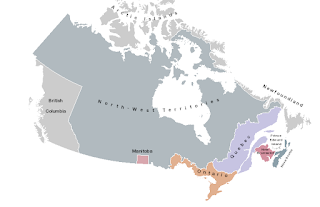
The accompanying map is helpful for context, given many Canadians believe a myth that these "provinces" democratically joined "The Dominion of Canada", and in the form they are today. There is some very important history to learn to understand what Canada is and how it operates.
Canada's Origin Story
The answer of the Manitoba Act is only part of the story.
Canada was created and maintained by the British through a series of Acts of the British (later UK) parliament.
In 1867 it was a small number of British citizens (Western European, white, men) in a white minority part of the world who asked their government (Britain) to pass a law to create a new subsidiary of the British Empire. It wasn't the democratic will of the inhabitants, the majority of which weren't European and had their own existing (many democratic for centuries) governments. Many weren't even informed.
Some key acts to be aware of:
The 11 British North America Acts: It is actually BNA 1871 that confirmed Manitoba in the Constitution, as the British retained more control over Canadian law than they granted to the subsidiary governments on this side of the Atlantic. While Part VI of BNA 1867 (Sections 91-95 of the Canadian Constitution) created separate jurisdiction for federal and provincial responsibility, that limitation didn't apply to the British who could legislate at any level they wished - including the Canadian Constitution which only the British government could amend.
Statute of Westminster 1931 - this is when Britain granted several of its colonies, including Canada, the ability to have foreign policy. Technically Canada never declared war during the First World War, and "Canadians" participated in that war as British Subjects.
Canada Act 1982
: This is where the British terminated their power to legislate for
Canada. This is the (most likely) final British amendment to Canada's Constitution,
and the creation of a new amending formula allowing governments on this
side of the Atlantic to amend the Canadian Constitution.
SCHEDULE B, Part I, is the new Canadian Charter of Rights and Freedoms.
While the existing Constitution sections 91-95 clarified jurisdiction for federal and provincial governments, the new Constitution section 35 as well as Charter section 25 clarified jurisdiction and rights for Indigenous governments.
If you don't yet know what the Royal Proclamation 1763, Treaty of Niagara 1764, or the Quebec Act 1774 is, then you don't yet know the foundations of Canada or Canadian law.
Government jurisdiction
This origin story of Canada, which we should all have been taught, is critically important to understanding what happened.
I discussed earlier that there weren't mandates (to vaccinate, wear masks, "lock down", etc) that were targeted at individuals, only workplaces. Individual rights were not being restricted as no individual has a right to enter other people's homes or workplace and ignore policies set for those locations.
Multiple levels of government have created workplace and other health and safety policy relating to the current COVID pandemic: provincial (municipal), federal (Indian Act band councils), and Indigenous governments.
I use brackets in the above as the constitution separates jurisdictional powers between Canadian Federal, Canadian Provincial, and Indigenous governments. Municipal governments are provincially created and regulated corporations, and Indian Act band councils are federally created/regulated entities. These are not independent levels of responsible government, but bodies responsible to the level of government which created and regulates them.
The vast majority of what people think the protesters were asking for, to "end all mandates", was outside of the jurisdiction of the Canadian Federal government. Even if the Government of Canada wanted to end all mandates, they do not have the power under the Canadian Constitution to do so.
To say that in the reverse: The federal government, and Trudeau as Prime Minister, has nothing to do with a vast majority of the mandates protesters were angry about. These are independent decisions being made by multiple independent levels of government, primarily making use of independent public health units to help direct them during a critical time.
The type of centralized decision making that the protesters believed was happening is simply not possible. Public health mandates were not in any way a top-down decision made by a single individual, and health is primarily a provincial responsibility.
Canadian Parliaments: and what is a "minority government"
I believe Canada's Democratic Institutions have been weakened by the transition of Political Parties from being a caucus formed within and accountable to elected parliamentarians, to being unaccountable corporations operating outside of parliament that manipulate parliamentarians.
That said, Canada's Democratic Institutions are currently still far stronger than the protesters were alleging.
Justin Trudeau is currently the Prime Minister of Canada. He is not the King of Canada, and does not have the level of control that protesters seemed to believe he has.
Justin Trudeau is the current leader of the political party that has a plurality of seats in the House of Commons. This is a plurality, as the Liberal party of Canada would have needed 11 more seats to have a majority. The governing party must get support from at least one of the other larger parties (Green Party with 2 seats not sufficient) in order to pass any specific legislation. The opposition has a majority, and can force an election nearly any time (there are some minor procedural limitations) if they wish to discontinue the current parliament and try again at changing the makeup of parliament.
For those who don't pay attention, the most recent general election was in September 2021. Canada has general elections (for all seats) and by-elections (for a subset), and doesn't actually have a "federal election" with a common ballot question for all voters. The House of Commons is not an electoral college like the USA has to chose their President, although you couldn't tell from how the media (foreign or domestic) misreports Canadian elections as if they were in any way similar to US presidential elections!
So, is it possible for Trudeau to act as a Dictator? No, not in the slightest.
He can act like a petulant child, and constantly say unhelpful things when in front of a microphone, but he can't act as a dictator.
Is Trudeau the best person to be representing Canada's federal
government as the Prime Minister? For this my personal opinion is
strongly: No!
I don't like Trudeau for many reasons, and consider him an embarrassment as Prime Minister. Not liking Trudeau is not the same thing as believing he has power that he doesn't have, or that I will blame him for things which he has no control over.
I also want a better Prime Minister, but I want that accomplished through stronger democratic institutions and not by an angry mob of people who didn't spend any time trying to understand the basics of how governments work making DEMANDS of any democratically (by Canadian standards) elected government.
Advise for First Time Protesters
When listening to interviews of protesters (live streams, more formal media, etc), or reading things said by and interacting with supporters on social media, I got the distinct impression that this is the first time they have protested or paid attention to any government policy.
I can't recall exactly, but I started getting more politically involved in the early 1990's. I've been to many protests over the decades, some which I now recognize as ineffective as I didn't really understand the relevant governance institutions in my youth. I've since met many politicians (before, during and after they were parliamentarians), some of which I even consider friends.
I would love to share as much as I can, and encourage others to get more politically informed and involved. I do, however, believe it is critical that you do your homework if you want to be effective.
Research if the policy concern is real. There are many political opportunists out there, including politicians and the media, who want to use you as a pawn for their own special interests. They will abuse confusion to create anger, and then point you at a target of their choosing which likely has nothing to do with the alleged problem.
Learn about the organizers of any political movement or protest. Don't assume that their "marketing brochure" is actually their goal. Don't take actions based on marketing which is regularly deceptive, but based on actual goals of the organizers.
Learn what level of government, and sometimes exactly which department or ministry, the policy you are critical of originates from. The easiest way to get dismissed by anyone involved in governance is to come to them with problems which have nothing to do with them: they are very busy, and teaching you basic civics is not part of their job.
Recognize that protests involved people, and possibly banners, flags and other such things to make the message clear. They don't involve heavy machinery, which is what changed the nature of what might have been thought of as a protest into something illegal, and what many considered a siege.
I have been wanting to write something about the protest since it started on January 28. I wanted to get my thoughts together before I posted, but the longer I wait the more facets emerge which are worthy of discussion.
I will start with the federal government regulation that is claimed to have sparked these protests. I say "claim" because most of what I hear from protesters and supporters has nothing to do with this policy, but larger social issues I'll put into separate articles.
This is a simple/boring workplace health and safety policy.
Throughout this pandemic, politicians and the media have done a very poor job in explaining public health policy. This isn't a left-vs-right politician or left-vs-right media issue, as I feel they have all done a poor job.
You will see politicians and media discussing "lockdowns", "mask mandates" and "vaccination mandates" without any context given to clarify the meaning of these phrases.
There is a percentage of the population, higher in western countries, who think of themselves as individuals and not members of a larger society. When they hear these phrases it means "I am being locked down", "I am being mandated to wear a mask", and "I am being mandated to get a vaccine".
When you look at the policies that have been put in place by Canadian municipal, provincial/territorial and federal governments (and the parallel First Nations governments) they have all been workplace policies: "this workplace is temporarily closed", "this workplace requires masks", "this workplace requires vaccines".
These two concepts are not remotely the same thing, and yet politicians and the media have been conflating the two. Given few people read the policies, they incorrectly believe individuals are being regulated rather than workplaces.
If individuals were mandated, then their individual rights and freedoms may be impacted. However, since no individual has a right to enter someone else's workplace, their individual rights have not been impacted.
I am unaware of a jurisdiction within what most people call Canada where essential services that citizens require to survive being temporarily closed or requiring vaccinations, and thus am unaware of any scenario where individual rights are in question.
Ignoring unusual political ideology, putting on a mask to enter other people's workplaces shouldn't be any more controversial than a requirement to put on pants. I am so glad there isn't a big movement to protest "workplace clothing mandates".
I may not be a fan of the specific language the Prime Minister decided to use in his announcements or media releases, or how other politicians and the media reported on it. I think many individuals in these professions aren't very good at their jobs.
I may find Justin Trudeau embarrassing as Prime Minister, and want to change the seriously flawed Democratic Institutions that puts someone with his lack of qualifications into that position, but that doesn't impact my opinion on this workplace health and safety policy.
Health and Safety policy for Truckers
Once you recognize we are talking about workplaces and not individuals, then how this relates to the trucking industry becomes more obvious.
As part of their work, truckers need to enter other peoples workplaces: their trailers get loaded and unloaded, and along the route they travel for days do as all humans do: eat, sleep, go to bathrooms, etc. Not all of these things are done entirely inside their cab, and involve entering people's workplaces.
The regulation is not specifically about the health & safety of the truckers, but of all those people whose workplaces they must enter to do their job.
There is a claim truckers are being fired or their individual charter rights are being infringed if they are not vaccinated. While this may be how some individuals feel due to their political biases, this is not what the policy is saying.
Nobody has a right to enter other people's workplaces and ignore the health & safety policy of those workplaces. Truckers who individually decide to disqualify themselves from entering workplaces required for their job have made a personal choice.
Truckers have special drivers licenses, and many other regulations which simply do not apply to people in other professions. These regulations, many of which were lobbied for by truckers unions to protect truckers individual and collective rights, are all quite normal.
Someone with only a class G1 Ontario drivers license isn't being "fired" or their rights somehow impacted if the job requires that they have a valid Class A (full or restricted) or Class D Ontario drivers license. Not all truck drivers are allowed to drive all types of trucks.
This specific policy has been highly politicized for reasons that can be discussed later, as they relate to the broader political issues at the heart of these protests. Under normal political circumstances I seriously doubt these workplace health & safety policies would have been controversial for anyone.
Many people are writing and talking about how they are happy to see the end of 2020. I posted a Goodbye 2018 as that had been a rough year for me personally. I hadn't been up to writing anything that year since April when I wrote about my new job.
Since then I have been thinking about my future in a different way than I had in the past. The year 2020 introduced changes greater than 2019.
This Gregorian calendar year I paid close attention to a series of events: Wet'suwet'en blockades, conspiracy theories about COVID and China, and the most recent Black Lives Matters protests. This inspired me to learn more, and I started some self-directed anti-racism training. As I was born in a place recently called Sudbury, Ontario, Canada, this quickly lead me to learning about the indigenous civilizations and peoples of this homeland.
This has been a important turn in my own life. While there was some discomfort during this year due to the pandemic, I feel I am in a better position to be helpful in upcoming years.
I now see the events around me differently.
COVID-19
I have not suffered a personal loss from COVID this year, but I know other people who have. The people who are closest to me have been taking this pandemic seriously and following health and safety measures. This is regardless of what politicians have been saying, as I don't see politicians as a source of truth.
I have observed a selfishness with more distant acquaintances I interact with online. Given the fatalities have been considerably higher than terrorism, logic would suggest that the willingness to respond would also be higher. This has not been the case, and I've noticed that some of the very people who are willing to take extreme measures to fight "terrorism" have been claiming that there are "civil liberties" concerns with the minor public health measures required to fight COVID.
Due to this childishness, various governments have been forced to step in and impose lock-downs: and there are people so oblivious to the world around them that they are protesting the lock-downs.
It has been a big lesson in how "privileged" some people feel, especially when I compare to what I've learned about how the civilizations that have existed in parallel with European colonialists and settlers have been treated since contact. These Canadians feel like their rights are being taken away, while feeling no need to acknowledge or compensate First Nations, Métis, or Inuit for the many orders of magnitude greater infringements that are ongoing today. It is hard not to file Canadian complaints under "white privilege" and leave it at that.
Its the economy, stupid
Or is it the stupid economy?
The non-medical hardships people are feeling from the pandemic are a matter of policy choice. I wrote about this in April when people first started suggesting that public health measures were too strict, and it was gong to harm "the economy".
Western countries using western economic systems, and countries that have had flawed western economic theories forced on them by the Breton Woods Institutions (World Bank and IMF), are extremely fragile. They superficially appear to be working while there are no emergencies, but the slightest problem (IE: unaccountable lending to home "owners") and you end up with a crisis.
We have known for a long time that due to travel patterns and ongoing human expansion that a global pandemic was inevitable. While avoiding the pandemic would have been hard (reducing population expansion, moving away from western worldviews which think of humans as separate from the natural world), reducing the fragility of the economy would have been comparatively easy. And yet, nothing was done.
Ask yourself why we haven't had something simple like a Universal Basic Income for decades? This is far less expensive to administer than the patchwork of subjective government programs currently being operated, and would have been an obvious part of emergency preparedness. People in countries like Canada have no legitimate reason to ever worry about paying for the necessities of life, no matter what external emergency exists. If anyone is worried about these things, it is by design and those policy makers who are generating this crisis should be held accountable.
Instead we have dishonest misdirection, claiming it is public health measures that are causing personal financial problems rather than unaccountable policy makers. Anyone who is feeling a hardship should be angry, but not at lock-downs but incompetent (or often corrupt) politicians who didn't put adequate emergency preparedness measures in place.
Those of us in Ontario will likely be in for some additional politician created economic hardships in 2021. We currently have a "Finance Minister" who thinks it is possible to "accidentally" travel to a Caribbean island during a global pandemic -- all while preparing early to have staff send social media posts to try to hide that vacation travel. This isn't a person I would trust loaning $20 to, so obviously not something trustworthy enough to be a cabinet minister, and especially not trustworthy to be allowed anywhere near Ontario's finances.
The flag of the Hamilton & District Labour Council proudly flies at 1492 Land Back Lane, on a roadblock put up to protect people now being forced to occupy that land to stop its destruction by "developers" who falsely claim they purchased legitimate title to it.
I am a settler Canadian who has been following this issue closely. My wife and I are godparents, and I reached out to their father. He recently retired, but was actively involved in the teachers union. He has put me in touch with other people, and I hope this discussion will continue across a large web of relations.
While donations from more PACs would be great, I think having the discussion is important whether it results in a donation or not. I strongly believe building better relations with the First Civilizations of North America (AKA: Turtle Island) would make us all better peoples.
Check your western world views & privilege at the door...
The western focus on individuality pulls us out of time, and our thinking of land only for its resources and benefits to humans pulls us out of place. We don't think of ourselves as the same peoples we were 7 generations ago, and we do not feel responsibility for those generations or toward the 7 generations yet to come.
A tiny slice of our shared history
Possibly back in 1192CE the Haudenosaunee (Iroquois) Confederacy formed their participatory democracy via the Great Law of Peace - their oral constitution. This brought together the 6 nations comprising Mohawk, Onondaga, Oneida, Cayuga, Seneca, and Tuscarora peoples.
This is important to know that this is an advanced democratically governed civilization, and not only nations or tribes. Far too many westerners believe that Europeans brought civilization and democracy from Europe. We must realize that while the Haudenosaunee is a democratic civilization, at contact time the Europeans were merely subjects of Christian monarchs.
Westerners self identifying as progressive are trying to tackle problems in Canada including environmental degradation, massive income inequality, racism, sexism and sexual violence, LGBTQ+ and gender diversity. These are all systemic problems brought to North America by colonialism.
In 1784CE, Sir Frederick Haldimand signed a decree that granted a tract of land to the Haudenosaunee (AKA 6 nations) in compensation for their alliance with British forces during the American Revolution. The Haldimand Tract extended for 6 miles (10 km) on each side of the Grand River from its source to Lake Erie. First Nations across what is called Canada have remained aligned with the British and Canada and participated in the war of 1812 as well as volunteering during the first and second world wars (European vs European wars, dragging along allies), in order to protect the parties of those treaties.
The British parliament passed the British North America Act in 1867, and the Canada Act in 1982. After theoretically legislating a separate country into existence, the British have tried to wash their hands of any responsibilities in relation to British North America. Despite that, section 35 of the Canadian Constitution Act 1982 affirms the treaties First Civilizations made with the British as well as with Canada. While the Canadian government tries to avoid honoring its treaty obligations, the rule of law isn't on their side.
In the 1920’s the Six Nations of the Grand River applied for membership in the League of Nations (what later became the United Nations). The UK forced its colonies to block their entry. If this type of blocking sounds familiar, we need to remember that Canadians like to be upset at China for doing similar with Hong Kong and Taiwan.
The ongoing Canadian protest against first civilizations
Fast forward a few more generations, along with the ongoing genocide by Canada against indigenous peoples (MMIWG, TRC, etc), to today.
You will find a tiny postage stamp within the Haldimand Tract for a "reservation". The Indian Act created bureaucracy (band council, which is accountable to the Canadian government and not the 6 nations, and thus doesn't have jurisdiction) offers a PDF map that you can zoom into.
The Six Nations of the Grand River reserve is the largest First Nations reserve in Canada by population, and the second largest by size. Population density is very high, and they need room to grow for their civilization to be healthy. This overcrowding is already a problem today, and will obviously be a crisis situation long before 7 generations into the future. As they have relations with the land and each other that westerners wouldn't have, expecting them to just move away from their civilization is not reasonable.
Looking at the maps you can see that Caledonia is a close neighbor. The city is constantly attempting to expand closer and closer to the postage stamp sized reservation, putting settlements on land that the 6 nations need to house their own people. While land disputes are ongoing in the courts, the municipality sells as if they had been granted title. After dishonestly and deliberately initiating a dispute, the municipality will call in the OPP to enforce illegitimate court injunctions (biased courts that exist on the tract, judges living on tract, mayor who bought a house intended to be built on disputed land -- all obvious personal conflicts of interest).
After the OPP commits violence, they and the media that repeats their statements without investigation will falsely claim it is the 6 nations that are violent. It is rubber bullets and tasers so far, but the police have murdered land defenders before. In this round of disputes the OPP themselves send out biased edited footage, not acting as law enforcement but as a partisan political entity.
Every time the media reports the indigenous people as protesters, they are reporting the issue backwards as it is the Canadian government and uninformed Canadians that are doing the protesting against the constitutionally protected legal rights of First Civilizations.
The arresting of a journalist is another reminder of horrible things Canada does with little political consequence, and yet Canadians complain when China does the same. Given what happened at Ipperwash with the killing of Dudley George, with a lack of media presence recognized as part of the problem, allowing journalists on-site will save lives!
Money is not the real issue
It is part of the dishonesty of the Canadian governments that food donations and financial support is required for this camp at this time. While embarrassing to the honor of Canadians, it is a fact we need to deal with today in order for these peoples to have opportunities to receive justice in the future.
Common with other First Civilizations, the Government of Canada owes the 6 Nations of the Grand River a considerable amount of money. Some of that money is held in Six Nations Trust Funds, being controlled by the Canadian government. While these funds are intended to be for the benefit of 6 nations, Canada has instead been using it as a slush fund for government projects such as McGill university and the Welland Canal.
The Impact Assessment Agency of Canada hosts a booklet submitted by 6 nations which offers some context. This provides an appropriate overview of the financial obligation that Canada owes to 6 nations, as well as the climate action and other policies that the nation wishes to push forward.
To quote from the purpose section introducing the booklet:
Six Nations of the Grand River understands that Canada does not have enough money to bring historic land issues to resolution under the existing land claims policies.
This booklet is an explanation of Six Nations’ land and financial grievances against the Crowns of Canada and Ontario and the need for the establishment of a new perpetual care and maintenance mechanism. A mechanism that would benefit the Six Nations Peoples and their posterity to enjoy forever, while continuing
to share the Haldimand Tract lands and resources with our neighbours.
As a reminder to Canadians afraid of the concept of Land Back: They don't want your pool. They don't think with European worldviews, and while they are owed more money than the Canadian economy is worth they have no intention of having Canada declare bankruptcy or filling ships to send people back to the places where they are indigenous.
Given how much education around what Canada is most Canadians are missing, the role of teachers is obvious to me. I know there has been improvements from when I was in high-school in the 1980's, but we have far to go as a young country (whether we consider it created in 1867, 1982, or some other date). It wasn't only in residential schools were a biased western worldview was taught.
Why unions?
While westerners tend to have tunnel vision caused by individuality, unions are one of those exceptions where westerners will come together on an ongoing basis for common cause. This is most important when political action extends beyond labour disputes with fellow western institutions (western corporate employers). The 6 nations land dispute is an opportunity for unions to build relations with a First Civilization. It is the learning and building good relations that is the most important, although meeting Anthony Marco's challenge would also be great.
Note: I've written my Ontario MPP and Canadian MP about these issues approximately once a month. I posted the first letter, but I have learned so much more about the 6 nations since. I encourage others to do the same.
It violates international law in its treatment of the people of Hong Kong and in its treatment of religious and ethnic minorities, such at the Tibetans and the Uighurs in China. In short, China is threatening our interests and our values.
I posted the following reply:
I would like Michael Chong to compare how Canada treats the Haudenosaunee to how China treats Hong Kong.
The Haudenosaunee are more legitimately understood as a separate nation from Canada, having founded their democracy back in 1142 and having signed treaties with the British. The British and Canadian governments have been working to eradicate that democracy for a long time, with residential schools and the Indian Act band councils being part of Canada's desire to remove democracy. The British and Canada even blocked the Haudenosaunee joining the League of Nations which later became the United Nations.
Hong Kong was "leased" by the British for 99 years, and apparently the western world wants it to remain British.
Why is Canada trying to hold China to a higher standard than it holds itself? Whatever one might think about Chinese domestic policy, I don't think it is appropriate for Canada to be critiquing it until it has its own house in order.
I didn't want to get into the role of the Catholic Church in ongoing colonialism, and how that relates to the Uighurs. What I'm saying is that each of the bad things that Canadians like to criticize China for, Canada did first, did for longer, and continues to do.
As the Christians like to say (to others, but rarely themselves), “Let him who is without sin among you be the first to throw a stone at her.”
A reply I received from another Canadian citizen was unfortunate, asking "How can someone form a democracy before that term even landed at it's shores?".
I replied:
The English and Greek languages might not be indigenous to North America (Turtle Island), but the concept of democracy is not European. Many North American civilisations were healthy democracies back when the majority of Europeans were merely subjects of monarchies.
In the case of the Haudenosaunee Confederacy they are a participatory democracy, which is more democratic than the representative democracy which the Canadian governments use.
This is made worse by the fact that Canada is allowing itself to become more centralized, with the unelected PMO having power that previously was vested in the House of Commons. Michael Chong was co-editor of "Turning Parliament Inside Out: Practical Ideas for Reforming Canada's Democracy" which discusses these critical issues.
Many Canadians can't wrap their minds around the idea that the concepts behind democracy are not uniquely European.
I am aware it is uncomfortable for people to realize this, but this is actually how white supremacy works. White supremacy isn't about individual skinheads fighting for "white nationalism", but primarily about systems built upon the notion that Europeans and their ideas are automatically superior to everyone else. The current concept of the Dominion of Canada, a British colony that continues to disrespect its treaty relationships with first civilizations, is founded on that notion.
Michael Chong went on to indicate that:
Four of the Five Eyes intelligence partners, Australia, New Zealand, the United States and the United Kingdom, have banned or put restrictions on Huawei's involvement in their networks. Canada is unilaterally alone in failing to take action.
So, the UK and the 4 British colonies where colonists currently outnumber indigenous. In this context we should understand the FVEY as an axis of white supremacy, and not as an entity that has the best interests of North Americans, democracy, or human rights in mind.
December 11 update.
Michael Chong regularly intervenes in parliament to comment about China, and regularly posts videos to Facebook. It appears to be constant repeats of the same argument.
I couldn't figure out why he was so obsessed with China until I looked closer at his biography. His father was born in Hong Kong and immigrated to Canada in 1952. This was his father moving from a part of a country under a temporary British occupation (Hong Kong under 99 year lease to the British) to a country under apparent permanent British occupation. The Dominion of Canada was created as a satellite government of the British Empire. This British dominion has been dishonestly trying to claim exclusive governance over lands the British signed treaties with First Nations to share.
When I hear Michael Chong talking about "human rights" with respect to China, he appears to really only mean "British". I believe it should be understood and respected that China is not British, and that Hong Kong is no longer British since that "99 year lease" ended in 1997. The idea that being British is good and being not-British is bad is not something I think a modern politician should think or be promoting. The British Empire has had, and continues to have, a poor record when it comes to human rights -- so much that a special United Nations Declaration on the Rights of Indigenous Peoples was required to clarify that colonies such as Canada must start to protect at least a bare minimum of human rights.
I suspect I wouldn't have to ask Michael Chong's opinion on the British Monarchy, and if Canada should mature to become a republic and no longer embarrassingly being part of the British Empire under the British Monarchy. The ongoing harm of colonialism is something we should be trying to repair, not something to be proud of and promoting internationally.
While the "very fine people" meme about Trump isn't entirely accurate, it is accurate to suggest Canadian Prime Minister Justin Trudeau is guilty of worse. Trudeau tried to suggest false relevancy when he offensively included the suggestion that "freedom of expression is not without limits" when discussing a teacher being beheaded as an act of terrorism. Suggesting that the teacher who was murdered had any fault at all is more dangerous than negotiating with terrorists, and grants power to that terrorism. This should not be tolerated, and I am glad that many people are condemning Justin Trudeau for this.
My position on tolerance of religious influence on governments and politics has been clear. I am a strong supporter of secularism, which is the separation of church (the threat) from a democratic state (what needs to be protected).
My beliefs aren't tied to any specific religion, but on how hierarchical and powerful a political structure exists, and how much they wish to impose their views on non-adherents and other political structures. If you want to know which religion I wish to have extracted from politics you only need to look at the List of religious populations, with the top 3 threats at this point in history being Christianity, Islam and Hinduism. Any religion that is political enough to want to have its own nation-state is in my opinion a foreign political threat against any democratic state.
Every Canadian should be aware that Catholic Monarchs funded Christopher Columbus, and that it was papal bulls from the Catholic Pope that were used to justify the doctrine of discovery. The concept is simple: subjects of Christian Monarchs were to take over lands (and remove existing civilizations, including democratic nations) not under the control of Christian Monarchs.
It is not only residential schools which the Pope and Catholic Church specifically, and Christianity generally, has never adequately apologized or made amends for. These papal bulls, which the colonial United States and its supreme court considered international law, have never been rescinded. This means that the political interference from Christianity against North American civilizations, parts of which have been recognized as a form of "race-based genocide", is still considered current policy of the Catholic Church.
The Vatican was granted permanent observer state status in 1964, and while it hasn't applied to be a member is given considerable privileges. Let this sink in...
In the 1920’s the Haudenosaunee Confederacy, also known as the Iroquois Six Nations from Grand River Ontario, applied for membership in the League of Nations (what later became the United Nations). The UK forced its colonies to block their entry, a civilization that had a democracy that dated back to the 1100's, and yet the political headquarters of a specific denomination of a religion is able to directly influence the United Nations.
While the specific violence being discussed in France this year wasn't perpetrated by Christians in the name of Christianity, the relationship seem obvious to me. Countries such as France have a very sorted history with carrying out extreme violence in the name of religion, including on Turtle Island. Where I type from today was part of New France and later the British colony of Quebec, province of Canada, and most recently part of what is currently called Ontario. (It is actually unceded Algonquin territory)
Given that history there was a fight for freedom by separating church from France, specifically reducing the influence of the Catholic Church. This is a hard-fought process that has been ongoing for over a hundred years, and secularism ( laïcité ) is currently a constitutional principle of France. It isn't yet perfectly separated, but it is headed in the right direction.
Given this history, it should be no surprise that the French will aggressively and justifiably push against the very notion that the harmful influence of the Catholic Church should be allowed to be replaced with harmful Islamic political interference.
As Christianity was successful in falsely claiming that their political influence was only a matter of culture or spiritual beliefs, Islamic politics does the same. There is something fundamentally different between the political influence of church (especially any that have state aspirations) and culture, and it is both offensive and dangerous to equate the two. In fact, allowing the influence of religion within politics is opposed to the concept of multiculturalism, especially from the most aggressive religions such as Christianity and Islam which seek to impose themselves onto others.
While Saint-Pierre and Miquelon are the last piece of French territory in North America, I applaud the Quebec provincial government for following the lead of France in separating the Catholic Church from Quebec. Allowing the Catholic Church to administer healthcare and education, the two primary responsibilities of a province in Canada, should be recognized as a dark time in Quebec history. Their ongoing fight for laïcité should be both applauded and emulated within the rest of Canada, and hopefully eventually the rest of the world.
I found Justin Trudeau offensive when he tried to one-up Singh's offensive attacks against Quebec's progressive Bill 21 during the last federal election. I am offended this year when he suggested that someone being critical of religious doctrine by showing pictures did anything remotely wrong. For me this is not a matter of freedom of speech or multiculturalism, but an example of Trudeau and others who agree with him being apologists for terrorism and related religious threats to democratic states.
Justin Trudeau and other Canadians must start to do better!
The yearly debate about whether the poppy is a political statement bumped into a special form of Canadian patriotism this year, namely the mainstream media's opposition to US based Amazon and subsidiaries such as Whole Foods Market.
I want to start with Whole Food Market's ban on political symbols being added to work uniforms. On this I have mixed feelings.
There are some types of jobs, such as those that are providing specific government services, where employees need to be, and be seen as, impartial. This isn't possible if employees in specifically sensitive positions are allowed to wear political and/or religious symbols. I don't think this need for impartiality exists with someone working at a grocery store, and I don't think Whole Foods was attempting to make that argument.
In their case they were trying to keep the increasingly divisive politics outside of the workplace. Whether the law should protect or prohibit that, I don't have that strong opinion on and can be convinced either way. I've seen how large companies like Google are having problems with divisive politics within the company, but I don't think we need policies to allow large companies to function. (See Cory Doctorow's How To Destroy Surveillance Capitalism)
I've personally gone through all stages of the remembrance day and poppy debate.
In my youth I believed what I was told, which is that this is a symbol to remember war veterans and the horrors of war so that we will do everything we can to avoid war in the future. Many of my uncles on my fathers side, and my grandfather on my mothers side, were war veterans so I wore the poppy proudly. It never occurred to me there was any other way to think.
In my early 20's (in the 1990's) I started to notice the symbol being used to promote Canadian patriotism and Canadian military campaigns. This to me felt like the opposite of reminding us why we should avoid war, but instead promoting some of the very "us vs them" mentality that leads us to war. I've read numerous articles over the years discussing how many veterans in a variety of commonwealth countries (and the UK itself) have the same complaint.
I stopped wearing the poppy. In recent years I became aware of the White Poppies, and was considering that.
This year as part of my antiracism training I learned about the origins of the Dominion of Canada. I was already not patriotic, and am less so as I better understand how Canada was formed and the existing civilizations that Canada is still working to eradicate.
Treaties were signed between European and North American nations, where the Europeans haven't upheld their side of the treaties.
How legitimate is is for Europeans to
claim they created a nation separate from themselves without the
permission of the civilizations and nations that existed (and continue to exist) in North America prior to and after European contact?
Many of these North American nations were already long standing democracies, while the European Christian monarchies were not. Those subjects of Christian monarchies were given permission to replace existing civilizations via a series of papal bulls from the Pope that have yet to be rescinded.
Has Canada and Brittan always been on the side of "freedom and democracy"? Is it only a specific subset of wars and veterans that we should be honoring, and if so which ones?
What about the decedents of 6 nations war veterans where the Ontario and Canadian governments are still trying to violate treaties and kick them off their own land (See: 1492 Landback Lane).
Was a new country formed when the British North America Act was passed in 1867 by the British parliament?
Was a new country formed in when the Canada Act was passed in 1982 by the British parliament?
Will a new country be formed if Canada declares itself a republic and members of the new parliament and immigrants no longer have to swear allegiance to the British monarchy?
To me it is obvious that the poppy is a political statement, even if most of the people wearing it aren't yet aware of that statement. We need to be able to discuss these political issues if ever we are to understand these statements.
The poppy is a symbol of the United Kingdom and the Commonwealth. While this is well understood in Ireland, it seems most Canadians are unaware. I don't consider the poppy to be less political than a symbol for Black Lives Matter or gender diversity -- things which I believe shouldn't be considered controversial at all. I have recently become aware of how colonialism brought with it gender binaries, the patriarchy and racism, and this is part of my opposition to the commonwealth. Allowing the poppy while disallowing BLM/LGBT symbols only makes the political statement more obvious.
While Whole Foods was seeking to ban all political symbols, organizations like Global News apparently told employees that poppies should be warn by all Global News anchors, reporters and radio hosts appearing on television and in online videos from Sunday November 1st to Wednesday November 11th.
While I now recognize that objectivity and individuality are white privileges, and that objectivity doesn't exist (including in journalism), it is important for journalists to be aware of the biases they are projecting while wearing these political symbols. If they are seeking to be seen as more impartial, then they shouldn't be wearing these symbols.
This is not a uniquely Canadian debate, or debates in the colonies, but is also being discussed within the UK.
This is based on something I wrote as feedback after listening to a Canadaland episode.
I was cringing during parts of your discussion with Former Executive Director of the World Sikh Organization Jaskaran Sandhu. I thought I would offer a different perspective.
The term secularism has been co-opted recently by those with a very specific political viewpoint that differs from the secularism movement. They are suggesting that secularism is the separation of state from church, meaning only that the state doesn't intervene in the church.
The term is more broadly understood to be the separation of church from state, meaning that it was understood that over humanity's history that it is the church that is the aggressive entity that needs to be removed from any attempt at fair/impartial governance infrastructure.
Some shortformed it by saying "separation of church and state", to include both the times when the state was the aggressor as well as the more common situation when the church is the aggressor.
Prior to British occupation, religious groups in India were able to coexist fairly peacefully. This is in relative terms, considering how "peaceful" other regions of the world were in the same eras, and the occupation of India by the Mughal Empire.
In a far worse version of what Trump can be seen doing today, the British lit and fanned flames of religious tension as a divide-and-conquer technique.
At the time of independence there was widespread opposition to partition from across religious groups (including Hindus, Muslims, Indian Christians, Sikh, etc).
The leadership of the Muslim League would not agree to Indian independence without partition. Partition resulted in massive deaths (estimates between 200,000 and high estimates at 2,000,000, and it was so messy that we will never know).
Partition looms over the thoughts of Indians to this day as one of India's darkest moments (and considering the occupations, "The Emergency", and other events that is saying something). My mother-in-law survived it, living near Kolkata at the time. She won't talk about it, but what I have heard is horrifying.
I am someone who believes in Indian reunification, and one of the many things that stands in the way of that ideal is the reduction of secularism that happened in India post-partition. With some Muslims being seen to "take their ball and go home" and cause so much death during partition, this eroded secularism such that Hindu nationalists have been trying to take over the remaining parts of India. Narendra Modi's BJP is an obvious result of partition, with Muslims being less safe in India and elsewhere as the years go on.
It is understood that some horrible things have been done in India to the Sikh by Hindu nationalists. This is because of a lack of separation of church from the state (true secularism) in India, and not as you and your guest were suggesting that it was a lack of separation of state from church. Creating a separate Sikh state will not make Sikh more safe, but will result in further segregation and make Sikh living outside of their separate state less safe.
I would hope it is recognized that segregation is not some ideal we should actively strive for, whether we are talking about different races or people with different religious views.
Note: I am not advocating for assimilation, with Canada being a country that claims to be secular but pushes Christian world views onto occupants. This includes peoples that pre-dated European/Christian colonization/occupation. Residential schools aren't the only Christian atrocities against non-Christians in North America.
I'm advocating for the government to be free from any religion within the operations of government, and religion to be free of government within one's home and religious communities.
I'm of European descent, born in 1968 in what was recently called Northern Ontario. This year I stated my antiracism training, and it has been a major eye opener.
I've spent decades fighting against treating land, animals, people and ideas as "property", and the treatment of "property" as exclusivity without responsibility. In taking a course on Indigenous Canada I have learned that this is down to world views, with the view I've been fighting against being one of the core aspects of European world views.
Now that I'm aware of the differences in world views between those indigenous to North America and those indigenous to Europe, I have come to understand that my personal views are more North American than the Canadian federal, provincial or municipal governments that claim to represent me as a citizen. I've come to understand that fighting for environmental, economic and social justice is very wrapped in decolonisation, antiracism, and fighting against "white supremacy" (I mean the systemic kind, not focused on individuals).
I have watched a few videos and Q&A sessions with Annamie Paul at this point, and I'm happy to see that she represents a perspective I want to see in parliament. She isn't a person of Caribbean descent that is going to simply work within the existing Eurocentric political culture in Canada, but work to change it.
She isn't running in my electoral district, so my views on her won't affect my vote, but I can still donate to help encourage people in Toronto Center to support and vote for her.
I watched a video which CPAC put up of the new Green Party leader Annamie Paul speaking with reporters.
I became increasingly annoyed at the number of times reporters asked the same form of question. In their corporate minds, Annamie Paul was just placed as the CEO of the corporation called the Green Party of Canada. They wanted to know the many different ways that she would dictate commands to those the media insisted were subordinate to her, whether that be staff at the party, elected members of parliament, or candidates. She had to constantly remind them of what a "healthy democracy" looks like.
Many of the biases of these reporters were obvious, even though these reporters would likely falsely claim they weren't biased.
As I have watched Canada's democracy decline over my lifetime, I have noticed that rather than the corporate media holding politicians to account that they are only making things worse. Rather than recognize that democracy is more healthy the more decentralized it is, the corporate media has constantly manufactured fake scandals when any group displays healthy democratic traits by having disagreements in a bottom-up rather than top-down fashion.
The Global Greens Charter sets out the principles that bind Greens from around the world together:
Participatory Democracy
Nonviolence
Social justice
Sustainability
Respect for Diversity
Ecological Wisdom
My greatest critique of Elizabeth May and the current federal council has been their willingness to abandon the first principle (participatory democracy) in order to appease Canada's anti-democratic corporate media or align themselves with the corporate structured parties.
I believe Elizabeth Mays support of "party proportional representation" (measured via the Gallagher index) was itself an abandonment of this first principle. Political parties are merely corporations, and a centralizing focusing on corporate brands over participants or representatives is unhealthy for democracy. While Canada needs electoral reform in the form of ranked ballots in single and/or multi-member districts to make representatives more representative of citizens, electoral systems focused on corporate proportionality only makes the existing corporate focus worse.
I also believe the idea of having a leadership 'vetting committee' was an example of the problem. While I strongly oppose the adoption of US-style primaries as it is unhealthy for Canadian democracy, having a top-down group deciding who is allowed to be nominated makes this bad situation worse. While the party may sometimes need a media spokesperson separate from the caucus elected leader (especially whenever there isn't an elected caucus), that person should never be falsely treated by the media as some sort of CEO.
It is beyond time for reporters employed by Canada's corporate media to recognize their harmful role within Canadian democracy. The media can't oppose a healthy democracy and then be surprised when fewer and fewer people are willing to go to them to find out what is happening in Canada. If they want public support, they need to switch to offering the public service of holding politicians to account. This means treating elected representatives as accountable to citizens, not acting as if MPs were employees working within "elected" corporations (IE: political parties).
While I support participatory democracy over representative democracy, lets at least ensure that elected representatives are never expected (or preferably even allowed) to have loyalty to corporations over citizens.
When Italian explorers happened upon Turtle Island in 1492, they found existing nations with governance structures different than what they had experienced with European nations.
While Europeans had a very top-down hierarchical structure largely based on hereditary monarchs or "elections" with a tiny number of elite electors, some of the nations in North America were using what is often called a participatory democracy. Kainerekowa (the Great Law of Peace) of the Haudenosaunee is widely recognized as one of the oldest democracies in the world (possibly founded in 1142).
The North American nations often had hereditary leaders that would help talking circles come to a consensus. This leader is a trained facilitator and promoter of group values and interests, and is able to act as a spokesperson with others about these common interests. Many roles in various societies worldwide are inherited, often because training is required from an early age.
Each nation had their own words for this leadership. Europeans called these facilitators chiefs, an anglicization of the french word chief.
Europeans and North Americans had hereditary leadership, but they were extremely different. People with european worldviews need to remember that their bad experiences with hierarchical hereditary leadership doesn't apply to other forms of hereditary leadership.
England incrementally became more democratic (Magna Carta in 1215, Kings removed in the 1600's), but it wasn't until 1918 with the Representation of the People Act that England had a system which we could recognise today as a democracy. Typical of patrilineal societies, it wasn't until a decade later that women received a more equal vote, something that wasn't a problem in matrilineal societies such as seen in many north american first nations. With European history coming from a top-down hierarchical feudalistic system, the form of democracy that was formed was similarly top-down hierarchical with Prime Ministers or Presidents having far more power than is reasonable for an individual to have. While these positions are periodically elected, they have the ability to impose top-down decision making between these elections.
Rather than allowing indigineous peoples of North America to retain their existing governance systems, colonial governments imposed top-down colonial structures on them. This can still be seen today with the Indian Act imposed "elected" bureaucrats the colonists called "elected band councils", with the colonial government still ignoring obligations towards restoring indigineous self determination and governance.
While indigineous peoples of North America have been forced to adjust to interacting with the hierarchical colonial state and society, many have been able to retain their more participatory governance traditions. In some cases the hereditary facilitators work with "elected" band councils, in some cases those facilitators overlap between both systems, and in some cases the Indian Act councils have no legitimacy at all. In some cases the hereditary leadership were killed off by colonists, so these nations are forced to only have the imposed hierarchy. How great an impact the imposition of European hierarchy has had on a nation is specific to that nation.
Personal belief...
While I only recently started to learn the truth about North American history, I have always believed in the decentralisation of power. I believe it would be greatly beneficial for Canadians to abandon European world views about governance (and many other things), and to adopt some of the more decentralised decision making methods that are indigineous to this continent. There are many ideas imported and imposed from Europe that we would be best to move away from.
References....
One of the most interesting thing I have found in my antiracism and indigineous north american studies is that all the information is widely available, if only people are interested to look for and read it. I could provide a huge list of references, but I have arrived at my current beliefs through reading, listening to and watching a wide variety of sources authored by people living within areas which Euopeans histocally declared to be the "United States" and "Canada".
As part of the Indigenous Canada course , Dan Levy has been hosting some informal conversations after each module. When the topic of indigenous peoples wanting their land back comes up, Paul Gareau has jokingly said something along the lines of "we don't want your pool".
I heard another version of that thought during the Q&A section of a talk given in February by Dr. Kim TallBear titled "Decolonizing (≠ Reconciling): Science, Technology, and Indigenous Relations". The entire talk is amazing and worth listening to, but if nothing else please listen to this 4 minute clip.
"Settlers are always afraid you are going to do to them what they have done to everyone else. So whatever their fears are, it tells you they know what their ancestors really did. Nobody is going to kick anyone out."
"You can be kin to us without being us." ... "Be careful about making those types of appropriative claims".
"The settler state cannot be redeemed. It is not the project."
"We are telling ourselves the wrong story, and its very difficult to make changes with the wrong narrative guiding us."
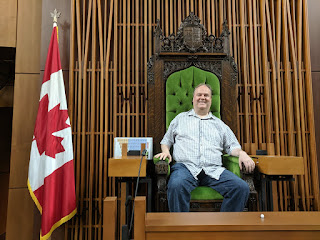
This afternoon, on unceded Anishinabe Algonquin territory currently the subject of treaty negotiation, a British colonial ceremony was held. With parliament only retaining British tradition, we were reminded by a "speech from the throne" that to this day the settler-state doesn't fully recognize the two groups who make up Canada: European colonialists/settlers and the peoples who had already been here for thousands of years.
As I read the text of the Speech from the Throne I noticed a few themes. I could easily put them under an overall headline of the continuation of narrowly harnessing European world views to attempt to further public policy goals.
A romanticization of over 150 years of the members of our European settler-state parliament dealing with challenges, with no recognition or harnessing of the experiences of the peoples who were already here for thousands of years.
The continuation of the European entitlements vs responsibility world view around rights, which generate the wealth and power inequality at the heart of the gaps in social responsibility.
A continuation of creating excessively large centralized entities which then need excessively large government regulatory and police interventions, rather than enacting policy to decentralize.
The speech properly recognized that we are in a series of crises, including not only COVID-19 but also climate change. There is also a crisis of legitimacy, where more Canadians are questioning the status-quo of how government has been operating.
Solving these problems requires far more change than postponing travel plans. I believe it will require re-evaluating our world views, including abandoning the entitlement concept which allows individuals and groups to exploit resources (land, animals, people or ideas) to extract private benefit without any responsibility. We need to think of rights as responsibilities we have to each other, not as entitlements we take from everyone and everything else.
Systemic racism is mentioned, but only in the unfortunately common "white" way of incorrectly believing that systemic racism relates to systems which include individual racists. Systemic racism relates to the norms and practices within society or an organization. Good individuals can participate in systemic racism, as it is not about individual attitudes.
One large class of examples is the use of police forces as a top-down mechanism to ensure conformity to policies that deliberately avoid discussing the roots of the disputes that armed officers are thrown into. Those who are talking about defunding or abolishing the police are discussing changing our focus to solving societal problems at their roots. This is not limited to the "war on drugs" or "war on mental illness", but many other government policy manufactured armed conflicts.
While claiming to recognize that Black Canadians and Indigenous Peoples are over-represented in the criminal justice system, the government had already stated it believed that criminal code amendments were needed for those who neglect seniors. It is Canadian society, including the federal and provincial governments, that are neglecting seniors and yet through a "white" lens the solution is always seen to narrowly focus on criminalizing individuals.
I feel there is a similar problem with bringing up that it is unacceptable that any citizen be arbitrarily detained in relation to Michael Kovrig and Michael Spavor. The same is true of Meng Wanzhou being detained in Canada as a barely veiled part of trade and other disputes between the USA and China.
The RCMP has excessively close ties with a specific subset of foreign agencies and foreign political interests, and none of the above listed people would currently be detained if it were not for the hypocritical structural failures of the Canadian government. The Five Eyes (FVEY) membership overlaps with the countries that opposed the Declaration on the Rights of Indigenous Peoples (Australia, Canada, New Zealand, and the United States -- all British colonies, with the UK itself being the fifth member of FVEY). This should cause us to openly question what world views and values these agencies have in common.
The government can claim in a speech that this is something for which all Canadians stand united, but that doesn't make it true.
The backward-facing discussion of "Web giants" is another example of the government trying to hide its own policy failures. Our communications infrastructure involves government granted monopolies in the form of right-of-way for physical wired infrastructure and spectrum allocation for wireless. Phone companies were created by provincial and federal governments, and cable companies via municipal monopolies. While this infrastructure exists as a matter of government policy, private interests were allowed to buy up all these monopolies such that only a handful of private sector companies claim exclusivity over most of the right-of-way and spectrum. These companies then also bought most Canadian media that would be communicated over those wires and wireless, including television stations, radio stations and newspapers. (Note: Given their lobbying record, I consider CBC to be a Bell partner and not a public service)
When companies involved in physical entertainment distribution (Book/tape/CD/DVD sellers including Amazon, DVD rental by mail including Netflix) wanted to move existing distribution online, they were blocked by these vertically integrated monopolists. When possible Canadian online competitors to cable were formed, the monopolists blocked it (convincing parliament to pass targeted legislation against already existing iCraveTV and JumpTV). The same was true even of companies that offered search engine services that could be paid by advertising. These companies that could not get big enough were forced out of existence, and those who did were forced to move into the media creation and/or distribution business in order to be allowed to exist at all in a policy world controlled by analog-era media monopolists.
So the "Web giants" are a result of failed government policy around phone and cable companies, and compounding these failures can't possibly solve anything.
I have come to believe that the only solution to this problem is structural separation. The monopolies, whether for right-of-way or spectrum, should be returned to municipalities and managed as a utility in the same way as all other critical infrastructure is. All over-the-top (OTT) services, including two-way voice (phone) and one-way simultaneous video (cable/etc), would compete on a level playing field and no longer be legally allowed to leverage government granted monopolies.
Taxing new media to perpetuate problems caused by old-media monopolists will only make existing problems worse. This will only increase the cost of those services for Canadians, when those services are providing far better value than the old-media monopolists.
Shitts Creek was able to break the Emmy's record for the most wins of a single reason of a comedy only after it was able to break free of CBC and get wider distribution internationally on services such as Netflix. While we should be providing more stable funding to Canadian production through accountable government subsidies (not anti-competitive old-media entitlements), that money and any other subsidies should be moved entirely away from legacy OTT media companies (broadcasters, and BDU's like cable companies).
Having a "Universal Broadband Fund" is also counterproductive when that money is handed over to old-media monopolists. Necessary government support from the provincial and federal level should only be to municipalities building their own municipal infrastructure, and never to continue the harm of allowing private-sector monopolists to gain unaccountable control over that infrastructure. It is the local communities, through their municipalities, that should be setting infrastructure priorities and not those priorities being set in the boardroom of some distant private sector monopolist.
I was happy to hear a renewed commitment to reverse almost a hundred years of Canada's opposition to the policies that became the United Nations Declaration on the Rights of Indigenous Peoples. Canada needs to abandon its colonial period, and no longer side with Australia, New Zealand and United States as settler colonies of the United Kingdom. We should instead be moving forward with decolonisation in order to become a republic. As a settler Canadian I do not support the continued implication that Canada was formed only by two sets of European colonists (French and English), and that these Europeans took over this land through conquest rather than being honorable with our existing treaty partners and within ongoing treaty negotiations.